

For the better part of a decade, India’s FMCG giants built their strategies around one assumption: growth comes from cities. Premium SKUs for urban millennials. Digital-first campaigns targeting Tier-1 metros. Distribution muscle pointed at modern trade. Then the data shifted — and it shifted hard.
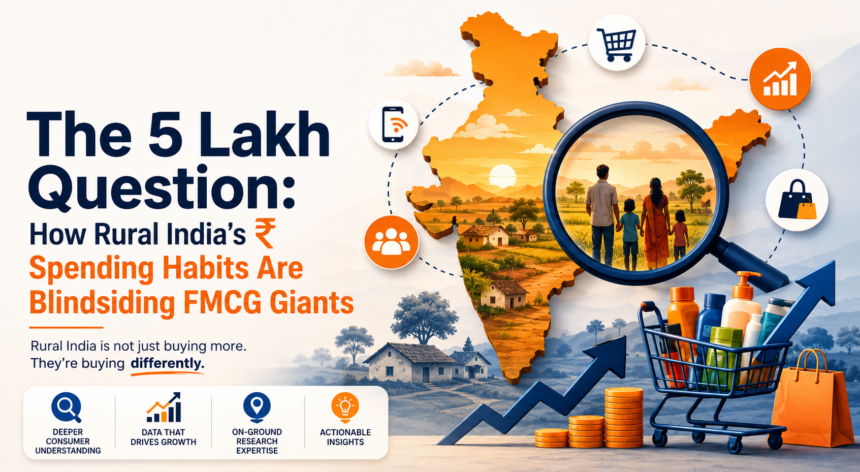
According to NielsenIQ’s FMCG Quarterly Snapshot, rural India outpaced urban markets for six consecutive quarters through Q2 2025, posting volume growth of 8.4% against 4.6% in cities. Across the same period, average rural basket sizes nearly doubled — rising from 5.8 items in 2022 to 9.3 items by 2024. Bharat is not just buying more; it is buying differently. And most FMCG brands are still reading yesterday’s map.
The household earning ₹5 lakh a year in a small town or semi-rural district — the heartland of India’s consumption story — does not behave like her urban counterpart. She is brand-aware but price-rational. She aspirational but deeply value-driven. She is online, but she buys at the kirana. Miss these nuances, and a well-funded FMCG launch quietly dies at the district boundary.
The Numbers Behind Bharat’s Buying Power
India’s FMCG sector is projected to reach USD 642.87 billion by 2030, and the rural segment is no longer a supporting character in that story — it is the lead. Rural markets already account for roughly 52% of FMCG volume nationally. Home and personal care categories, long considered urban territory, posted 7.5% consumption growth in rural pockets in Q2 2025. Over-the-counter health products grew 14.2% by value in the same period.
This isn’t a rural consumption revival story. It’s a structural shift. Rural household income inequality is actually declining — the bottom 5% of rural households grew their spending by 22.1% in 2023–24 compared to the prior year, while the top 5% pulled back by 3.5%. The middle is widening, not thinning. That middle is who FMCG brands need to understand — and most currently don’t.
Yet despite the numbers, product failures in rural markets remain stubbornly high. Why? Because the data brands rely on is either outdated, urban-skewed, or aggregated to the point of uselessness. Rural consumer behavior research requires granular, on-the-ground survey methodology — not a panel of 300 respondents from state capitals.
Case Study 1: The ₹50 Pack That Missed the Market
A mid-sized personal care brand launched a premium moisturiser range targeting semi-urban and rural women in UP and Bihar. Packaging research was conducted in Delhi and Bengaluru. The product was priced at ₹50 for a 30ml travel pack — positioned, in the brand’s own words, as ‘affordable premium.’
Sales in the first quarter were a fraction of projections. Post-launch research — the kind that should have been done before launch — revealed two problems invisible in urban research: first, rural consumers in the target districts already trusted a ₹10 sachet-format competitor that local kirana owners actively recommended; second, the ₹50 price point triggered hesitation not because it was expensive in absolute terms, but because it represented an unfamiliar single spend for a personal care item. The purchase decision framework was entirely different from what the urban panel had suggested.
The brand eventually reformulated its rural go-to-market, launching a ₹5 sachet to seed trials and a ₹25 refill pouch for repeat purchase. By conducting in-village surveys — tracking actual purchase occasions, asking about kirana recommendations, and mapping the ‘trusted product’ list in target households — they restructured a failing launch into a sustainable rural SKU strategy within two quarters.
The insight that turned it around was not exotic. It came from proper rural market survey methodology: speak to the shopper in her language, at her kirana, on her shopping day. That research should have preceded the launch, not followed the failure.
Case Study 2: When ‘Rural’ Wasn’t Rural Enough
A packaged staples company — flour, spices, pulses — ran a regional expansion into Maharashtra’s hinterland districts based on state-level consumption data and distributor interviews. The research painted a picture of underserved demand and minimal branded competition. The team entered confidently.
Eighteen months in, market share was negligible. The state-level data had obscured a critical local reality: in the specific districts targeted, a network of hyperlocal ‘chakki’ (flour mill) operators offered freshly ground flour on-demand for less than the cost of packaged alternatives. Brand equity for packaged staples, far from being a differentiator, was viewed with suspicion — associated with adulterant risk and inferior freshness. The consumer preference insight available at the district and block level told a completely different story from what aggregate rural data suggested.
The lesson was expensive but clear: rural India is not monolithic. The consumer behavior in a semi-urban district of western Maharashtra is distinct from that in an agrarian village two talukas away. FMCG consumer trends India analyses that flatten this variation mislead more than they inform.
What Winning Brands Are Doing Differently
Brands that are gaining ground in rural India share one operational trait: they invest in primary research before and during market entry, not just after a stumble. Dabur reported that rural volume growth outpaced urban for four consecutive quarters as of December 2024 — a result directly linked to its long-standing practice of village-level consumer tracking and sachet-format iteration. Hindustan Unilever’s Project Shakti network has for years doubled as a live feedback loop, not just a distribution channel.
The common thread: treating rural India as a research subject, not just a sales target. This means conducting rural market surveys at the block and district level, tracking the kirana channel as a primary influence point, and mapping seasonal income patterns that determine purchase timing. It also means understanding digital touchpoints — with 46 internet subscribers per 100 rural residents, the rural consumer is increasingly online, but her path to purchase still runs through the local trade.
The Research Gap Is the Opportunity Gap
Rural India’s ₹5 lakh household is not unknowable. She is simply under-researched. The brands getting blindsided are not failing because the rural market is irrational — they are failing because they are applying urban consumer logic to a fundamentally different decision environment.
Closing that gap requires granular Bharat consumer insights — the kind built through on-ground surveys, structured ethnographic research, and district-level segmentation, not just national panel data. For FMCG brands serious about capturing rural growth, the question is not whether to invest in rural consumer behavior research. The question is how long they can afford not to.
How Maction Can Help
Maction Consulting specialises in FMCG market research India, with deep expertise in rural consumer research across 20+ Indian states. If your brand is navigating rural market entry or trying to decode shifting Bharat consumer insights, explore our primary research services or reach out to our team directly.