


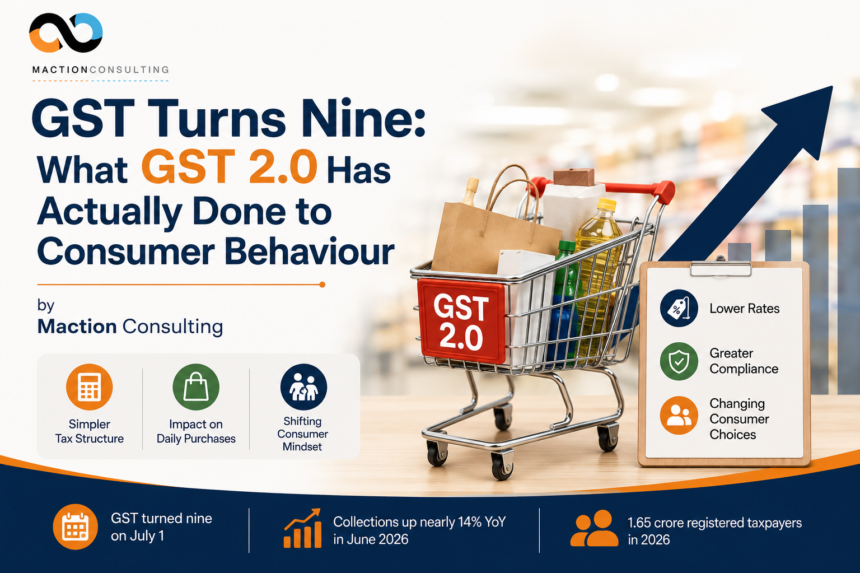
GST turned nine on July 1, and the government marked the milestone with the numbers it likes best: registered taxpayers up from 66.5 lakh in 2017 to 1.65 crore this year, gross collections that have grown roughly threefold since 2017-18, and June 2026 collections up nearly 14% year-on-year. Those are formalisation and compliance metrics — useful for a finance ministry press release, less useful for anyone trying to understand what actually happened to household spending after last September’s rate overhaul. That’s the more interesting — and more researchable — question nine months in.
What GST 2.0 Actually Changed
The reform that took effect on September 22, 2025 collapsed India’s four-slab structure (5%, 12%, 18%, 28%) into essentially two: 5% and 18%, with a new 40% slab carved out for sin and luxury goods. The 12% and 28% slabs were abolished outright, the compensation cess was scrapped for most goods, and individual health and life insurance premiums became fully tax-exempt. On paper, this was the single biggest simplification of India’s indirect tax structure since GST itself launched in 2017.
The Gap Between “Rates Fell” and “Prices Fell”
Nine months on, the honest research question isn’t whether tax rates dropped — that’s a matter of public record. It’s whether the rate cuts actually reached the consumer, and whether reaching the consumer changed anything about how they shop. Those are two entirely different things, and most public commentary on GST 2.0 conflates them.
A rate cut only shows up in a consumer’s basket if it passes through MRP revisions, and pass-through is never uniform. Categories with tight competition and organised retail (packaged FMCG, consumer durables) tend to reprice faster and more visibly than fragmented categories with thin margins and many small manufacturers, where a tax cut can just as easily get absorbed into distributor or retailer margin instead of the sticker price. Nine months is enough time for this gap to have stabilised into a pattern — but it’s a pattern that only shows up in category-level pricing and perception research, not in aggregate GST collection data.
Three Questions Worth Researching Right Now
- Did consumers actually notice? A rate cut that isn’t perceived doesn’t change purchase behaviour, no matter what the MRP tag says. Awareness and attribution — do consumers credit a price change to GST 2.0, a promotion, or just “things got cheaper” — is a basic but frequently skipped tracking question.
- Did the insurance exemption move the needle on penetration? Individual health and life premiums going fully tax-exempt is one of the more consumer-relevant changes in the reform, particularly for price-sensitive first-time buyers. Whether this translated into actual policy uptake, or just better margins for insurers, is a clean before-after research design.
- Where did the 12%-to-either-5%-or-18% reclassification create winners and losers? Products that moved from the old 12% slab didn’t all land in the same place — some dropped to 5%, others were pushed up to 18% depending on classification. Category-level perception of “did this get cheaper or pricier” is likely to be inconsistent even within a single aisle, which is exactly the kind of nuance a topline inflation number can’t capture.
Why This Matters More for Some Categories Than Others
The reform’s effects aren’t evenly distributed, and category strategy should reflect that. FMCG and consumer durables, both largely re-rated into the lower slabs, have the clearest incentive to have already converted a tax cut into a visible price or promotional story with consumers. Insurance has a structural opportunity most brands haven’t yet fully activated in messaging. And categories that shifted toward the new 40% slab — sin goods and select luxury categories — are managing a very different consumer conversation, where a price increase needs a materially different research and communication approach than a price cut does.
What Brands Should Be Measuring for H2 2026 Planning
- Price perception tracking at the category level, not just brand level — GST 2.0’s pass-through has been uneven enough that category context matters more than usual for interpreting your own brand’s price-sensitivity data.
- Attribution testing in purchase-driver research, to separate genuine tax-driven price movement from routine promotional activity in the consumer’s mind.
- A fresh look at insurance and durables penetration, the two categories with the most consumer-facing structural change, ahead of festive-season planning.
Frequently Asked Questions
Q: What changed in India’s GST 2.0 reform in September 2025?
GST 2.0, effective September 22, 2025, collapsed India’s four-slab structure into essentially two rates — 5% and 18% — with a new 40% slab for sin and luxury goods. The 12% and 28% slabs were abolished, the compensation cess was scrapped for most goods, and individual health and life insurance premiums became fully tax-exempt.
Q: Did GST 2.0 lower prices for Indian consumers?
Not uniformly. A tax rate cut only reaches consumers if it passes through to MRP revisions. Categories with organised retail and strong competition — packaged FMCG, consumer durables — tend to reprice faster. Fragmented categories with thin margins often see tax cuts absorbed into distributor or retailer margin instead. Nine months on, this pass-through gap has stabilised into a pattern that varies significantly by category.
Q: Which categories benefited most from GST 2.0?
FMCG and consumer durables, largely re-rated into the lower slabs, have the clearest consumer benefit. Individual health and life insurance, now fully tax-exempt, has a structural opportunity for penetration growth. Categories shifted to the new 40% slab — sin goods and select luxury categories — face a different consumer conversation entirely.
Q: What should brands measure after GST 2.0 for H2 2026 planning?
Three priorities: price perception tracking at the category level to understand whether rate cuts have been perceived by consumers; attribution testing to separate GST-driven price changes from routine promotional activity in the consumer’s mind; and a fresh look at insurance and durables penetration ahead of festive-season planning.
The Bigger Picture
Nine years in, GST has clearly succeeded as a formalisation and compliance story — the taxpayer and collection numbers make that case on their own. Whether GST 2.0 has succeeded as a consumer relief story is a separate, less settled question, and it’s the one that should matter more to brands planning the second half of 2026. The data to answer it doesn’t come from a finance ministry press release — it comes from category-specific consumer research run now, nine months after the reform, while the pass-through pattern has had time to settle but before festive-season demand complicates the read further.
If you’re planning category or pricing research ahead of the festive season, talk to our research team at Maction