

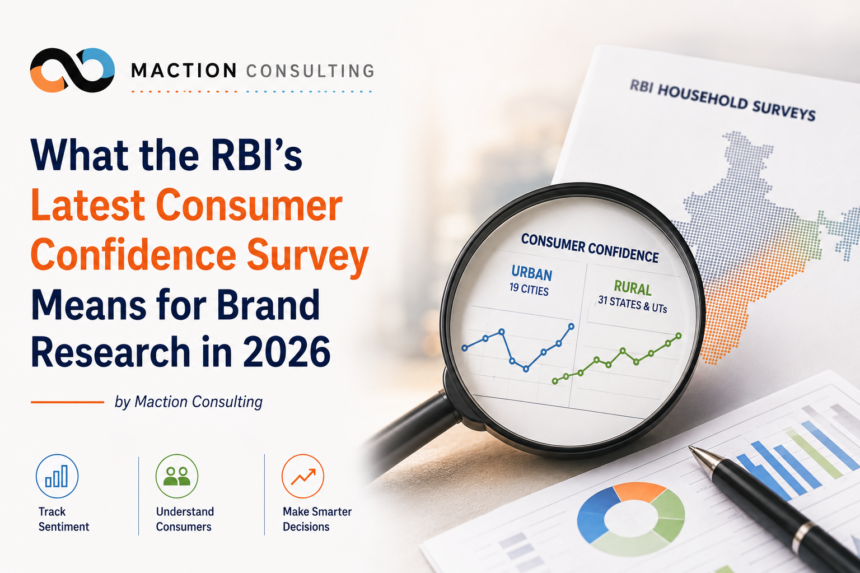
The RBI Consumer Confidence Survey — the Reserve Bank of India’s quarterly read on household sentiment across urban and rural India — quietly launched its July 2026 round earlier this month. On the surface, this is routine central banking. But for anyone doing brand or category research in India, this exercise is worth paying close attention to — not for what it says about interest rates, but for what it reveals about the country’s largest consumer sentiment dataset.
What the RBI Is Actually Measuring
The Urban Consumer Confidence Survey covers 19 cities and asks households qualitative questions about the general economic situation, employment, price levels, and their own income and spending — both current perception and where they expect things to be a year out. The Rural Consumer Confidence Survey mirrors this across 31 states and union territories. Running alongside both is the Inflation Expectations Survey, which asks households not just whether prices are rising, but by how much, across specific product categories, for the next three months and the next year.
Together, these three instruments form one of the largest, most methodologically consistent consumer sentiment datasets run anywhere in India — and they’ve been run on a repeating cycle for years, which means the real value isn’t any single wave. It’s the trend line.
Why This Matters Even If You Don’t Care About Monetary Policy
Brand trackers and category studies almost always ask some version of the same questions the RBI asks — spending intent, price sensitivity, outlook on personal finances. The difference is that most private research runs once or twice a year, on samples built for a single client’s category, with no visibility into whether a shift in the numbers reflects something specific to the brand or something happening across the entire consumer economy.
RBI’s data solves exactly that blind spot. If your brand tracker shows softening purchase intent in a particular quarter, the first question should always be: is this a brand problem, or a macro one? A national dataset running on the same cadence, asking overlapping questions, is the fastest way to answer that — without commissioning new fieldwork just to find out.
Reading Rural and Urban Sentiment as Two Different Stories
One structural detail in the RBI’s design is worth borrowing directly into private research: it treats rural and urban confidence as genuinely separate surveys rather than one national number split by geography after the fact. That distinction matters because rural and urban consumers are often responding to different pressures entirely — wage stagnation and input costs in one, job security and discretionary spending in the other — and a single blended confidence score tends to average away the more useful story.
Category and brand trackers that report one topline sentiment number for “India” are, in effect, doing what the RBI deliberately avoids. Categories with meaningful rural exposure — FMCG, agri-input, two-wheelers, consumer durables — get a materially better read when rural and urban confidence are tracked, and reported, as separate lines.
Inflation Expectations Are a Leading Indicator Most Trackers Skip
The Inflation Expectations Survey asks households what they think prices will do next — not what prices have already done. That forward-looking framing is unusual, and it’s exactly the kind of question most category trackers leave out in favour of backward-looking price-satisfaction metrics.
The distinction has real consequences for demand planning. A household that expects prices to keep rising over the next year changes buying behaviour today — stocking up, trading down, or deferring purchases — well before that expectation shows up in actual spend data. For any brand running quarterly or biannual trackers, adding a simple forward-looking price-expectation question is a low-cost way to catch a demand shift a full cycle earlier than a satisfaction-only survey would.
What This Means for Your Next Tracking Study
- Benchmark against the macro data, don’t just track your own brand. Pull the RBI’s published urban and rural confidence indices alongside your own tracker results to separate category-wide sentiment shifts from brand-specific ones.
- Split rural and urban reporting rather than blending it, especially for categories with meaningful presence outside metro India.
- Add a forward-looking expectation question, not just a current-satisfaction one — “how do you expect prices/spending to change over the next 3–12 months” catches shifts before they show up in sales data.
- Time your fieldwork to the RBI’s cycle where possible. Running trackers in the same windows as the RBI’s rounds makes it easier to compare your category’s trajectory against the national baseline wave over wave.
Frequently Asked Questions
Q: What is the RBI Consumer Confidence Survey?
The RBI Consumer Confidence Survey is a quarterly household survey run by the Reserve Bank of India across urban and rural India. It measures current and future perceptions of the general economic situation, employment, price levels, income, and spending. The results inform monetary policy decisions and provide one of India’s most consistent long-running consumer sentiment datasets.
Q: How often does the RBI release Consumer Confidence Survey results?
The RBI runs its consumer confidence and inflation expectations surveys on a repeating quarterly cycle. Results are published on the RBI website and fed into the Monetary Policy Committee’s deliberations. The July 2026 round covers both urban and rural households across 19 cities and 31 states and union territories respectively.
Q: How can brand researchers use RBI consumer confidence data?
RBI data provides a national macro benchmark that private brand trackers can be compared against. If your brand tracker shows softening purchase intent in a quarter, cross-referencing against the RBI’s consumer confidence index helps determine whether the shift is brand-specific or driven by broader economic sentiment — without commissioning additional fieldwork.
Q: Why should brand trackers separate rural and urban consumer sentiment?
Rural and urban consumers in India often respond to fundamentally different economic pressures — wage levels, input costs, job security, and discretionary spend patterns differ significantly. A blended national sentiment figure averages away the most actionable information. The RBI’s approach of running separate urban and rural surveys is a methodological standard that brand trackers in categories with rural exposure should adopt.
The Bigger Point
India’s consumption story right now is genuinely mixed — some datasets point to strong household spending intent this year, while central-bank-level sentiment tracking exists precisely because the picture on the ground is never as clean as a single optimistic headline suggests. Brands making category or pricing decisions in the second half of 2026 shouldn’t be choosing between the RBI’s macro read and their own brand tracker. The two are meant to be read together, and most research isn’t currently designed to make that easy.
If your brand or category tracker needs a redesign that accounts for macro sentiment, rural-urban splits, or forward-looking demand signals, talk to our research team at Maction.