

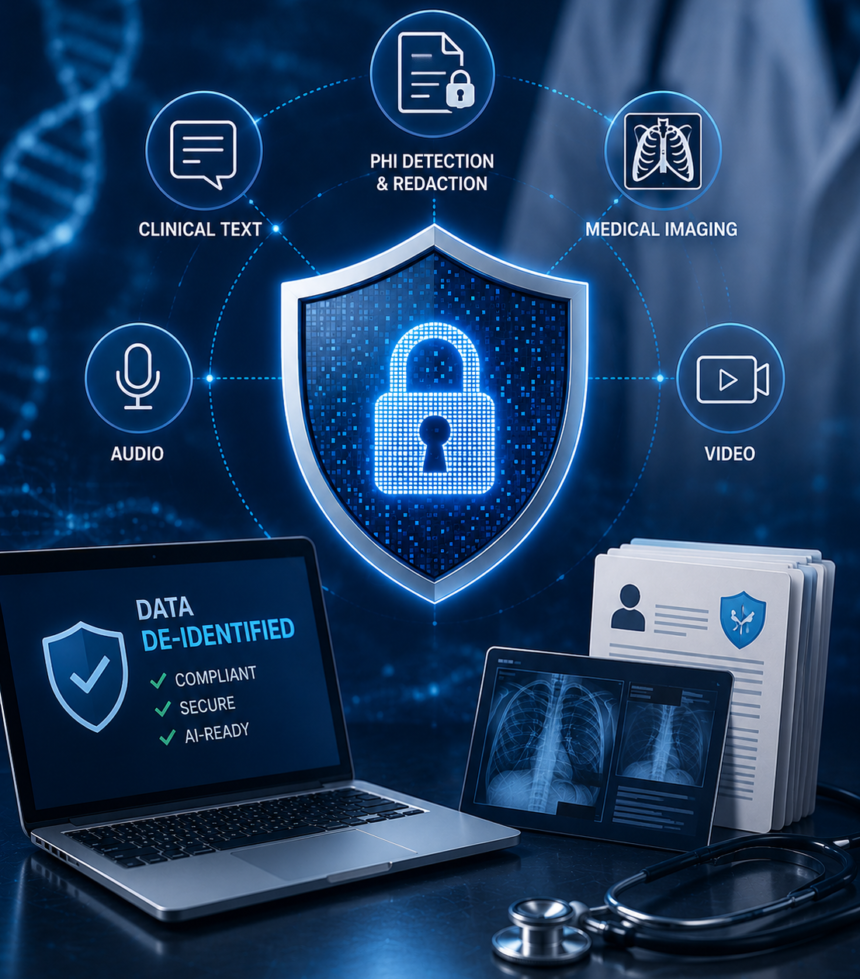
As healthcare AI adoption accelerates, the ability to de-identify sensitive patient data while preserving clinical value has become mission-critical. From NLP-driven PHI detection to multimodal redaction across imaging and video, a new class of providers is enabling compliant, AI-ready datasets.
This overview highlights leading vendors in medical data de-identification based on publicly available information, helping healthcare AI teams evaluate solutions across compliance, scalability, and modality support.
1. iMerit
iMerit provides expert-led, AI-assisted de-identification workflows designed for healthcare AI use cases across imaging, EHR, text, audio and video. iMerit’s approach combines automated PHI detection with human-in-the-loop validation, ensuring both regulatory compliance and preservation of clinical context.
Unlike pure-play automation vendors, iMerit supports custom model development and multimodal datasets, making it well-suited for organizations building production-grade AI systems.
Key Features
- Multimodal de-ID: imaging, video, audio, EHR, and text
- Human-in-the-loop validation with domain experts
- Custom de-identification model engineering
- Support for regulatory workflows (HIPAA, GDPR, ISO 27001, SOC 2)
- Secure delivery via Ango Hub platform
- SLA-driven accuracy (as low as 0.05% error targets)
Why iMerit Stands Out
iMerit combines automation + clinical expertise + custom model pipelines, making it particularly strong for high-stakes AI use cases (medical imaging, telehealth, regulatory submissions) where accuracy and auditability matter.
2. Datavant
Datavant is a player in healthcare data privacy, specializing in tokenization and privacy-preserving data linkage. Rather than traditional redaction, Datavant enables organizations to connect datasets without exposing PHI.
Key Features
- Privacy-preserving record linkage
- Tokenization of patient data
- Healthcare data ecosystem integrations
- Presence in life sciences and payer/provider networks
Limitations
- Focused more on data linkage than full de-identification workflows
- Limited support for imaging or video modalities
- Not designed for annotation-heavy AI pipelines
3. John Snow Labs
John Snow Labs offers NLP-based de-identification tools through its healthcare AI platform. It is widely used for structured and unstructured clinical text processing.
Key Features
- Pretrained clinical NLP models for PHI detection
- Support for EHR and clinical notes
- On-prem and cloud deployment options
- Customizable pipelines
Limitations
- Primarily text-focused (limited multimodal support)
- Requires in-house expertise to operationalize at scale
- No built-in human validation layer
4. Google Cloud Healthcare API (DLP Integration)
Google Cloud offers de-identification capabilities via its Healthcare API and Cloud DLP, enabling automated PHI detection across structured and unstructured data.
Key Features
- Scalable cloud-based de-identification
- Integration with healthcare data formats (FHIR, HL7)
- Supports text and some structured datasets
- Strong infrastructure and security
Limitations
- Limited clinical nuance without customization
- No human-in-the-loop validation
- Imaging/video de-ID capabilities are limited compared to specialized vendors
5. Amazon Comprehend Medical
Amazon provides PHI detection through Comprehend Medical, enabling automated extraction and redaction from clinical text.
Key Features
- Fully managed NLP service
- Fast deployment and scalability
- Entity recognition for PHI and medical concepts
- Integration with AWS ecosystem
Limitations
- Text-only focus
- No expert validation layer
- Requires additional tooling for compliance workflows
6. Privacera
Privacera focuses on data governance, access control, and privacy enforcement, including masking and de-identification capabilities across enterprise data systems.
Key Features
- Policy-based data masking and access control
- Multi-cloud and data lake integration
- Compliance-focused governance tooling
Limitations
- Not purpose-built for clinical AI datasets
- Limited support for imaging/video de-identification
- Requires integration with other tools for full workflows
Comparison Table: Medical Data De-Identification Providers
|
Capability |
iMerit |
Datavant |
John Snow Labs |
Google Cloud |
AWS Comprehend |
Privacera |
| Multimodal (Image, Video, Text) | ✅ | ❌ | ❌ | Partial | ❌ | ❌ |
| Human-in-the-loop validation | ✅ | ❌ | ❌ | ❌ | ❌ | ❌ |
| Custom model development | ✅ | ❌ | Partial | Partial | ❌ | ❌ |
| Clinical context preservation | ✅ | Partial | ✅ | Partial | Partial | ❌ |
| Regulatory-ready workflows | ✅ | ✅ | Partial | ✅ | ✅ | ✅ |
| Imaging & video de-ID | ✅ | ❌ | ❌ | ❌ | ❌ | ❌ |
| End-to-end AI pipeline support | ✅ | ❌ | Partial | ❌ | ❌ | ❌ |
iMerit: Built for AI-Ready Healthcare Data
While many providers focus on automation or governance, iMerit is designed for organizations that need production-grade, AI-ready datasets.
By combining:
- Advanced PHI detection models
- Domain expert validation
- Custom de-identification pipelines
iMerit ensures that data is not just compliant, but also usable for training high-performance medical AI systems.
Ready to Build AI with Safe, Compliant Data?
iMerit helps healthcare organizations transform sensitive datasets into secure, de-identified, and AI-ready assets.
Schedule a Demo or Talk to Our Experts Or Explore Our Medical Data De-identification Solutions