


By: Yedidya Schwartz, CTO at Quicklizard
For the last two years, most of the conversation around agentic commerce has been about discovery: how AI agents find products, compare options, and filter catalogs on behalf of human buyers. That problem has largely been solved. But it was never the whole problem.
Discovery without settlement is just a recommendation engine. For an AI agent to truly complete a purchase on a consumer’s behalf, it needs to be able to pay, instantly, automatically, and without asking a human to step in and authorize anything. Until recently, no standardized protocol existed to make that possible.
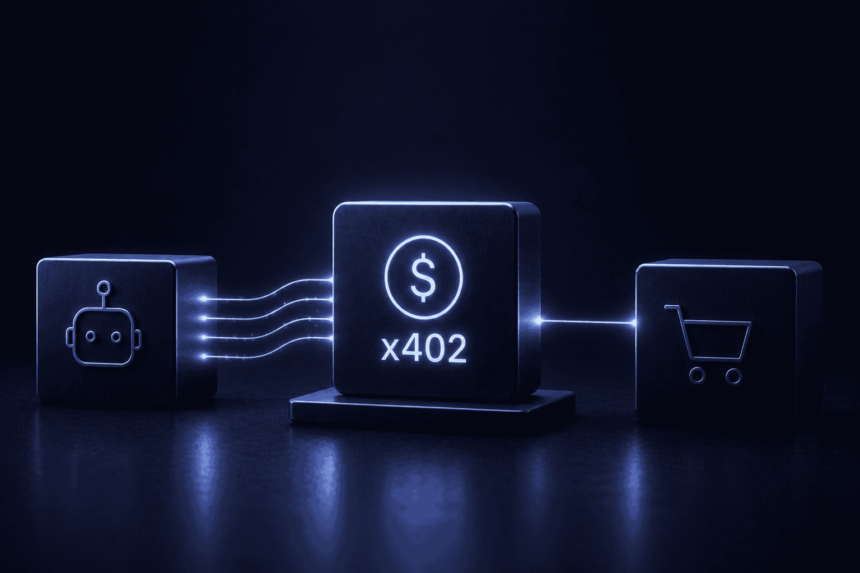
That has changed. x402, developed by Coinbase and co-founded with Cloudflare and Stripe under the Linux Foundation’s x402 Foundation, is the payment layer that fills that gap. It works by embedding a payment handshake directly into the web request itself. When an agent hits a service that requires payment, it receives a 402 response with everything it needs to pay and proceed: no account creation, no API keys, no human approval required. The payment happens as part of the same exchange as the request. There is no separate checkout flow.
The protocol is already in use at scale. To date, x402 has recorded over 165 million transactions and approximately $50 million in volume, with approximately 69,000 agents actively transacting across the protocol and over 480,000 agents transacting in total since launch, though independent analysis notes daily volumes remain modest and high-volume days are heavily influenced by tests (Coinbase, April 2026; Let’s Data Science, April 2026). The average call settles at $0.31 per micropayment (WebProNews, April 2026). But the direction is clear: x402 is no longer a concept. It is working infrastructure with real commercial activity running through it. Google, Microsoft, and Amazon Web Services joined as backers after the x402 Foundation was contributed to the Linux Foundation on April 2, 2026. The Foundation itself was co-founded by Coinbase, Cloudflare, and Stripe. Payment networks including American Express, Mastercard, Visa, Cloudflare, Shopify, Stripe, and Circle have all expressed early support.
For retailers and platforms, understanding what x402 demands operationally is no longer optional. It is quickly becoming a baseline requirement for competing in the agentic commerce stack.
How x402 Actually Works
The protocol is simpler than it sounds. Here is what happens when an AI agent makes a payment via x402.
The agent sends a request to a service. If that service requires payment, it returns a 402 response containing a small payment payload: the amount required, the accepted payment network, and a destination address. The agent reads that payload, constructs a signed payment transaction, and resubmits the request with the payment attached. The service verifies the payment, confirms it is valid, and returns the resource. The entire exchange happens in the time it takes to complete a standard API call.
What makes this commercially significant is what it removes from the equation:
- No account required. The agent does not need a pre-existing relationship with the merchant. The payment credential travels with the request.
- No intermediary. Traditional payment processors were built for human commerce, not thousands of sub-cent transactions between software services. Their fees alone can exceed the value of a micropayment, and most require a middleman and an operating history before approving a merchant. x402 removes all of that.
- Programmable by default. Because the payment is constructed in code and settled on a blockchain network, it can carry metadata and logic that traditional rails cannot. For retailers this is the most commercially significant property: pricing logic, promotional rules, and customer tier data can travel with the payment itself rather than being resolved in a separate system after the fact. An agent can arrive pre-loaded with proof of loyalty tier or promotional eligibility and have it honored at the moment of settlement.
- Micropayment-native. The protocol supports transactions as small as fractions of a cent, with facilitators running across Base, Polygon, Arbitrum, World, and Solana, and a free tier for up to 1,000 transactions monthly (Coinbase Developer Documentation, 2026).
Understanding the mechanics is the easy part. The harder question is what they mean for how your business competes.
Why This Changes the Commercial Architecture of Agentic Commerce
x402 does not just change how payments work. It changes how competition works.
In a market mediated by agents rather than humans, every provider sits in the same transparent pricing table, competing on equal terms with no homepage, no brand story, and no UI designed to create preference. Just a price, a service description, and a track record. The agent evaluates all three and moves on in milliseconds.
That has two concrete implications depending on where you sit in the business.
For technical teams, your payment endpoint is now a front-line commercial surface. Response time, data consistency, and payload accuracy determine whether agents can transact with you at all. These are no longer back-office concerns.
For commercial and strategy teams, the bigger shift is what x402 does to pricing. A price on a webpage is just a number. A price in an x402 payment payload is a commitment the agent will attempt to execute immediately. If your system cannot honor that commitment at the moment of query, the transaction fails. Price accuracy has moved from a merchandising concern to a settlement condition.
That shift opens up an entirely new commercial surface that most retailers have not yet considered.
The Micropayment Economy: A New Commercial Surface
One of the most underappreciated implications of x402 is what it enables below the traditional transaction floor. Because x402 makes sub-cent payments economically viable for the first time at scale, it creates a class of commercial interactions that have no equivalent in traditional e-commerce.
Consider a few examples that are already technically possible under x402:
- An agent pays $0.001 to query your real-time inventory API before deciding whether to proceed with a full transaction.
- A retailer charges a small fee for priority placement in an agent’s evaluation queue, payable at the moment of query rather than through a pre-negotiated advertising arrangement.
- A brand offers agents access to verified product data as a paid API service, with each query settled instantly via x402, with no separate registration step required.
None of these models exist today at any meaningful scale. But the infrastructure to support them is now live, and the retailers who move earliest will have the most influence over how these new commercial surfaces take shape. Which brings us to the question those early movers will need to answer first: how do agents decide who to trust?
Trust, Reputation, and the Compounding Score
The answer is reputation, and in an automated market it compounds faster than any human-mediated system ever could. In any system where agents make autonomous decisions at scale, reputation becomes infrastructure. x402 makes this dynamic explicit in a way that traditional commerce never did, and it surfaces a problem the ecosystem has not yet fully solved.
The core question is deceptively simple: if two services offer the same API call, one at $0.001 and one at $0.01, how does an agent know which one actually answers correctly? Price transparency is not the same as quality transparency, and in a market where agents are making millions of micro-decisions autonomously, the gap between those two things is where significant value is won and lost. The ERC-8004 proposed agent identity standard, still under development and not yet finalized, is already a step in the right direction toward achieving trust, which is critical in verifying a server’s reliability, but discovery, merchant adoption, and broader standards remain growth areas.
What is already clear is the direction the answer will take. Every transaction an agent completes via x402 generates a verifiable record: the payment was made, the resource was delivered (or was not), and the conditions of the exchange were met (or were not). Agent verification, anti-fraud frameworks, and Know Your Agent protocols remain the most underdeveloped layer and the most critical bottleneck. This is where most teams fail: commerce cannot scale if merchants and platforms cannot distinguish legitimate agents from malicious bots.
The inverse is equally true and more immediate in its consequences. A merchant whose price data is stale, whose payment responses are slow, or whose post-transaction fulfillment is inconsistent will see that reputation erode transaction by transaction: silently, automatically, with no human review process and no opportunity to appeal. In a machine-mediated market, there is no customer service call that rescues a damaged relationship. The score is the relationship. And building a good score starts with getting your own house in order.
What Building for x402 Actually Requires
For teams beginning to assess what x402 readiness looks like in practice, the work falls into three broad categories.
- Protocol integration is the most visible layer, and for most teams the most tractable: implementing the 402 response handler, constructing valid payment payloads, and connecting those payloads to a stablecoin wallet or custody solution capable of settling transactions programmatically. The Coinbase Developer Platform hosts a facilitator across multiple networks with a free tier for 1,000 transactions monthly (Coinbase Developer Documentation, 2026).
- Data architecture is where most teams hit their first real wall. x402 does not tolerate the data latency that traditional e-commerce infrastructure was built around. Prices, inventory levels, shipping costs, and promotional logic all need to be queryable in real time from a single authoritative source, because those values will be embedded in payment payloads that agents will attempt to execute immediately. Any gap between what your system commits to and what it can actually deliver registers as a failed transaction and a reputation penalty that compounds silently over time.
- Operational alignment is where x402 readiness is actually won or lost. Pricing decisions, inventory management, and fulfillment operations have historically been managed on different timelines by different teams with different tooling. x402 collapses those timelines to zero. The price your pricing team sets, the inventory your warehouse system reflects, and the fulfillment your operations team can execute all need to be synchronized at the exact moment an agent queries your endpoint. No amount of clean protocol integration or well-architected data layer compensates for an organization where those three things are out of sync. This is as much a leadership challenge as a technical one.
The Bottom Line
x402 is not a payments curiosity or a crypto experiment. It is the missing settlement layer that transforms agentic commerce from a discovery channel into a fully autonomous transaction channel, one where AI agents can find, evaluate, and complete purchases without any human intervention at any point in the flow.
The infrastructure is stabilizing faster than most expected. 2026 is the year the core agentic commerce protocols are maturing from early experiments into production infrastructure, with real transactions already running through them. The open questions around trust, evaluation, and reputation are real, but they are being worked on in a live market with real transaction volume, not in a whitepaper.
For retailers and platforms, the question is not whether x402 will matter. It is whether your pricing infrastructure, your data architecture, and your operational systems are ready to participate in a market where the payment is the authorization, the price is the commitment, and reliability is the only form of trust that counts.
The buy button was always a metaphor. x402 makes it obsolete.