


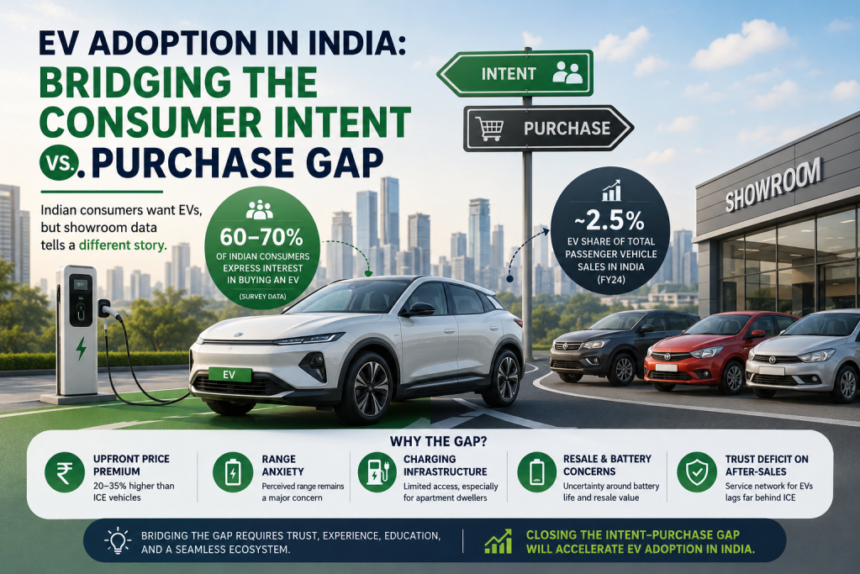
EV adoption in India has a paradox at its heart: ask any urban Indian car buyer today whether they would consider an electric vehicle, and the answer is overwhelmingly positive. Surveys repeatedly show that 60–70% of prospective buyers express strong interest in going electric for their next purchase. Yet when the same buyer walks into a dealership, the booking slip more often than not reads petrol, CNG, or hybrid. This is the heart of the EV adoption in India puzzle — a wide, persistent gap between stated intent and actual purchase behaviour.
For automotive OEMs, dealers, policymakers, and battery and charging infrastructure players, this gap is more than an academic curiosity. It directly shapes product roadmaps, pricing strategy, network investments, and government incentive design. Understanding why the Indian consumer hesitates at the final mile is where competitive advantage now lives.
This blog unpacks what the latest electric vehicle consumer survey data reveals, why the intent-to-purchase conversion is leaking, and what brands can do — backed by rigorous automotive market research in India — to close it.
The Intent Story: What Consumers Are Saying
Every major syndicated and custom study over the past 24 months echoes a similar headline: Indian consumers are emotionally aligned with EVs.
- Rising consideration: Across metros and Tier-1 cities, 6 in 10 prospective car buyers say EVs are on their shortlist.
- Two-wheeler momentum: Intent is even higher in the e-2W segment, where running costs are a primary driver.
- Environmental sentiment: Younger buyers (25–35) cite pollution, fuel costs, and “future-proofing” as top motivators.
- Brand openness: Consumers are willing to consider newer EV-first brands alongside legacy OEMs — a sharp break from traditional Indian car-buying loyalty patterns.
On paper, this paints a market on the verge of an inflection point. But intent is a leading indicator, not a transaction.
The Purchase Reality: What Showroom Data Shows
Despite enthusiastic survey responses, EVs accounted for only around 2.5% of total passenger vehicle sales in India in FY24 (EV sales FY26 data), with e-2W penetration at roughly 5–6%. The bulk of “intenders” ultimately drive home an ICE vehicle. Why?
Decoding EV vs petrol consumer behaviour through deeper qualitative and conjoint research reveals five recurring friction points:
- Upfront price premium — even with FAME II and state subsidies, EVs typically cost 20–35% more than equivalent ICE models.
- Range anxiety — perceived range matters more than actual range; consumers benchmark against weekend or family-trip use cases, not daily commutes.
- Charging infrastructure gaps — apartment dwellers in particular cite home-charging uncertainty as a deal-breaker.
- Resale and battery-life concerns — uncertainty around 5-year battery health and resale value materially erodes purchase confidence.
- Trust deficit on after-sales — service network density for EVs lags far behind ICE.
The pattern is clear: emotional intent is high, but rational risk perception kills the deal at the showroom.
Why the Gap Persists: A Deeper Behavioural Lens
Standard EV purchase intent studies often stop at attribute ratings. To genuinely diagnose the gap, brands need behavioural and decision-architecture frameworks.
Three under-appreciated drivers consistently surface in deeper research:
- Loss aversion: Buyers weigh the risk of a “wrong” ₹15–20 lakh decision far more heavily than the upside of fuel savings.
- Social proof scarcity: Most prospective buyers do not personally know an EV owner, denying them informal validation.
- Total cost of ownership (TCO) illiteracy: While TCO favours EVs over 5+ years, buyers anchor on sticker price and monthly EMI, not lifetime cost.
These are not product problems — they are communication, experience, and trust-building problems.
Case Study: A Premium EV Launch That Closed the Gap
A leading global OEM launching its first mass-premium EV in India ran a pre-launch intent study showing 68% favourable consideration. Three months post-launch, conversion was under 8% of qualified leads.
A follow-up custom research program — combining in-depth interviews, mystery shopping at dealerships, and a discrete choice conjoint — uncovered three fixable leaks:
- Sales advisors were under-trained on TCO conversations and defaulted to ICE comparisons on sticker price.
- 72% of intenders had never test-driven the vehicle; experience was the single biggest conversion lever.
- “Battery buy-back” and “assured resale” guarantees moved purchase intent up by 19 percentage points in simulation.
The OEM redesigned its dealer playbook, launched a battery assurance program, and built an experiential test-drive campaign. Lead-to-conversion improved by over 2x in the next two quarters.
Actionable Insights and Recommendations
For automotive brands, charging networks, financiers, and policymakers working to accelerate EV adoption in India, the strategic priorities are clear:
- Move beyond intent surveys. Layer in conjoint analysis, behavioural research, and journey analytics to identify real friction points.
- Engineer trust, not just product. Battery warranties, buy-back schemes, and transparent resale frameworks reduce perceived risk.
- Train the front line. Dealer advisors are the single largest conversion lever and the most under-invested one.
- Invest in experiential marketing. Test drives, EV pop-ups, and ride-and-drive events convert intent into commitment.
- Communicate TCO, not MRP. Reframe pricing conversations around 5-year ownership economics.
- Segment sharply. Fleet, commuter, family, and enthusiast buyers have entirely different barriers — generic campaigns underperform.
Frequently Asked Questions
Why is EV adoption in India slower than consumer surveys suggest?
The gap exists because surveys typically measure stated intent, while actual purchase behaviour is shaped by financial risk perception, charging infrastructure realities, resale uncertainty, and after-sales trust. Most consumers express enthusiasm in principle but default to familiar ICE choices when the actual transaction approaches. Closing this gap requires behavioural research, not just attitudinal surveys.
What does an effective electric vehicle consumer survey look like?
A high-quality EV study goes beyond rating scales. It combines quantitative segmentation with qualitative depth interviews, conjoint analysis to quantify trade-offs (price vs. range vs. brand), and journey mapping across the consideration funnel. The goal is to isolate the specific moments where intent erodes — typically at price disclosure, financing, and post-sales evaluation.
How does EV vs petrol consumer behaviour differ across Indian cities?
Metro buyers prioritise environmental and lifestyle factors and have better access to charging. Tier-2 and Tier-3 buyers weigh fuel cost savings and TCO more heavily but face sharper charging infrastructure constraints. Two-wheeler EV adoption is more uniform geographically because the use case (short commutes, parking-side charging) is more universal.
What role does automotive market research in India play for OEMs entering the EV segment?
Robust research de-risks product, pricing, positioning, and go-to-market decisions. From battery configuration and feature prioritisation to dealer network design and financing partnerships, every major EV-go-to-market lever benefits from custom research. OEMs that rely only on global benchmarks consistently misread Indian buyer psychology.
How Maction Can Help
Maction Consulting partners with leading automotive OEMs, suppliers, and mobility startups to decode the Indian consumer with precision. Our work spans EV intent and purchase studies, dealer mystery shopping, conjoint and pricing research, EV customer experience tracking, employee and dealer engagement, and post-launch tracking. With deep automotive vertical experience across two-wheelers, passenger vehicles, and commercial vehicles, we help clients turn intent into purchase — and purchase into loyalty.
If you are building or scaling an EV proposition for India, talk to our automotive research team about a tailored consumer insights program.
The Takeaway
The EV adoption story in India is not a story of consumer reluctance — it is a story of unaddressed friction. The intent exists in abundance. The job for OEMs, infrastructure players, and policymakers is to systematically dismantle the rational barriers that override emotional pull at the point of purchase. Brands that invest in deep, behavioural consumer understanding today will own the EV decade in India.