

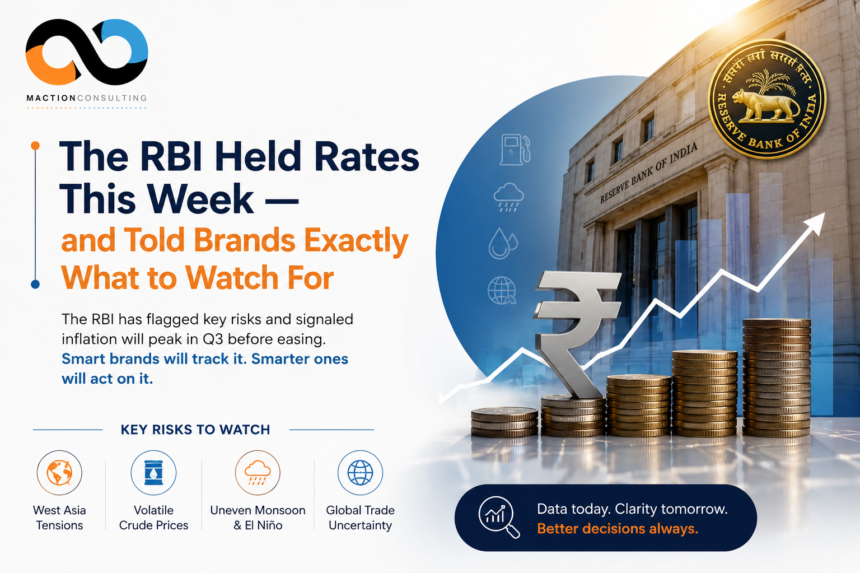
The RBI’s Monetary Policy Committee met this week and did, on the surface, nothing — the repo rate stays at 5.25%, the stance stays neutral, all six members voted unanimously. But Governor Sanjay Malhotra’s explanation for the hold was more useful to brands than a rate move would have been. He said the committee wanted “greater clarity” on the inflation outlook before acting, flagged renewed tensions in West Asia, volatile crude prices, an uneven monsoon under El Niño conditions, and global trade uncertainty as the specific risks it’s watching, and projected that headline inflation will peak in the October-December quarter before easing. That’s effectively a research brief handed to every brand doing category or pricing planning for the second half of the year — the RBI just told the market exactly which variables to track and when it expects the picture to change.
Reading the Hold Correctly
A rate hold can mean different things depending on why it happens, and this one is worth reading carefully. Malhotra was explicit that headline inflation has moved above the RBI’s 4% target, but characterised the increase as “largely driven by food and fuel prices,” with “little signs of generalisation of price pressures so far.” In plain terms: the RBI sees this as a supply-side shock, not evidence that inflation is broadening across the wider economy. That distinction matters enormously for how brands should interpret their own category data through Q3 — if the RBI is right, the current inflation spike is a fuel-and-food story specifically, not a signal that consumers are pulling back everywhere at once.
Malhotra also described the RBI’s posture as “neither dovish nor hawkish,” with future decisions depending entirely on how growth and inflation data evolve between now and the next MPC meeting on October 5-7. That’s a genuinely data-dependent central bank in real time — which means the coming eight weeks of inflation prints will carry more signal than usual for anyone trying to anticipate the next policy move.
The RBI’s Own Risk List Is a Ready-Made Research Agenda
What makes this MPC meeting particularly useful for brand and category planning is that the RBI named its risks explicitly rather than leaving them implicit. Four factors were flagged as key risks to growth and inflation: renewed tensions in West Asia, volatile crude oil prices, an uneven southwest monsoon amid El Niño conditions, and global trade uncertainty. Each of these translates fairly directly into a research question a category or brand tracker should already be built to answer:
- West Asia tensions and crude volatility — this is the same Strait of Hormuz-linked pressure that pushed June CPI above 4% for the first time in 16 months. The RBI’s own guidance that this could ease or worsen unpredictably argues for shorter research cycles on fuel-sensitive categories (transport, logistics-dependent FMCG, travel) rather than waiting for the next scheduled tracker wave.
- The uneven monsoon and El Niño exposure — this is a rural and food-category risk specifically, and one the RBI is watching separately from the fuel story. Category trackers with rural exposure should be probing food-price perception and rural sentiment as a distinct line, not folded into a single blended inflation question.
- Global trade uncertainty — relevant less for immediate consumer pricing and more for categories tied to export-oriented manufacturing employment and business confidence, which feed into discretionary spend with a lag.
“Peak in Q3, Ease After” Is a Planning Assumption Worth Testing, Not Just Accepting
The RBI’s forecast that inflation peaks in the October-December quarter lands directly on top of the festive season — the same window brands are currently producing inventory and planning campaigns for. If the RBI’s projection holds, brands are heading into their highest-stakes selling season of the year at the same time inflation is at its worst point of 2026, with relief only arriving after the season concludes. That’s a materially different planning assumption than “inflation is rising, full stop,” and it argues for building inflation-adjusted demand scenarios into festive research now rather than treating the RBI’s forecast as background noise.
It’s also worth treating the RBI’s own forecast as a hypothesis to test against category-specific data rather than a guarantee. Central bank projections are frequently revised, and the same uncertainty that kept the MPC from committing to a rate move this week is exactly the kind of uncertainty that should keep a brand from committing to a single demand scenario for Q4.
What to Build Into Research Before October
- Track the fuel-versus-broad-inflation distinction directly. Ask consumers what’s actually driving their price perception — fuel and transport, food, or a general sense that “everything costs more” — to test whether the RBI’s supply-side read matches what’s showing up in your category.
- Split rural monsoon-exposed categories from urban fuel-exposed ones, since the RBI is explicitly tracking these as separate risk factors rather than one undifferentiated inflation story.
- Build a pre- and post-October MPC comparison into festive tracking, so a shift in the RBI’s tone at the October 5-7 meeting can be cross-referenced against your own category data from the same window.
- Don’t treat “inflation eases after Q4” as fixed, run category confidence checks through the festive season itself rather than assuming the RBI’s forecast removes the need to monitor real-time sentiment.
Frequently Asked Questions
Q: Why did the RBI hold rates in August 2026?
The RBI’s Monetary Policy Committee held the repo rate at 5.25% unanimously, citing the need for “greater clarity” on the inflation outlook. Governor Sanjay Malhotra flagged renewed West Asia tensions, volatile crude oil prices, an uneven monsoon under El Niño conditions, and global trade uncertainty as the specific risks being monitored. The RBI characterised current inflation as largely supply-side driven — fuel and food — with little sign of broader generalisation across the economy.
Q: What is the RBI’s inflation forecast for Q3 and Q4 2026?
The RBI projected that headline inflation will peak in the October-December quarter before easing. This places the inflation peak directly on top of India’s festive season — the highest-stakes selling window for most consumer categories — with relief expected only after the season concludes.
Q: When is the next RBI MPC meeting after August 2026?
The next RBI Monetary Policy Committee meeting is scheduled for October 5-7, 2026. The RBI has indicated future decisions will be entirely data-dependent, making the inflation and growth prints between now and October especially significant for brands tracking consumer sentiment and category demand.
Q: How should brands use the RBI’s August 2026 rate hold for research planning?
The RBI’s four named risk factors — West Asia tensions, crude volatility, monsoon exposure, and global trade uncertainty — translate directly into research questions. Brands should track the fuel-versus-broad-inflation distinction in consumer perception, split rural monsoon-exposed categories from urban fuel-exposed ones, and build a pre- and post-October MPC comparison into festive season tracking.
The Bigger Point
A central bank holding rates steady rarely makes for exciting news coverage, but this particular hold came with an unusually specific explanation of what the RBI is watching and when it expects the picture to change. For brands planning category strategy and festive-season research, that specificity is more useful than a rate cut would have been — it’s effectively a public risk register for the next two months, and one that can be tested directly against category-level consumer data rather than taken on faith.
If you want research designed around the RBI’s own risk factors — fuel exposure, rural monsoon impact, or festive-season inflation sensitivity — talk to our research team at Maction.