

Indian consumer goods manufacturers are ramping up production by as much as 30% ahead of this year’s festive season, betting on the Onam-to-Diwali window that typically delivers close to a third of annual sales for many companies. Ad agencies are describing a similar mood on the marketing side, expecting brands to chase discretionary purchases that consumers postponed earlier in the year — the new phone, the home upgrade, the wardrobe refresh that got shelved between March and June. On paper, this looks like straightforward optimism. Underneath it, the consumer data brands are planning against is considerably messier than the production numbers suggest.
Two Signals Pointing in Different Directions
The bullish case for this festive season rests on real numbers: last year’s post-GST-cut festive window saw spending rise 8.5% year-on-year to roughly ₹6 lakh crore between September 22 and October 21, and that momentum reportedly carried into digital payments well into this year, with UPI transaction values and credit card spend both climbing through FY2026. Retail inflation was also unusually benign for most of the year, giving households more headroom for discretionary spending than they’d had in years.
The complication is that the inflation backdrop underpinning that headroom has shifted meaningfully since. Retail inflation crossed 4% in June for the first time in 16 months, driven by a combination of the Strait of Hormuz-linked fuel price increases and a weak monsoon, with several forecasters projecting a further climb toward 5-6% by year-end — directly across the same October-December window brands are now producing inventory for. A festive season planned around early-2026 consumer confidence is being executed against a meaningfully different inflation environment than the one that generated the confidence in the first place.
Why Aggregate Demand Numbers Can Mislead Category Planning
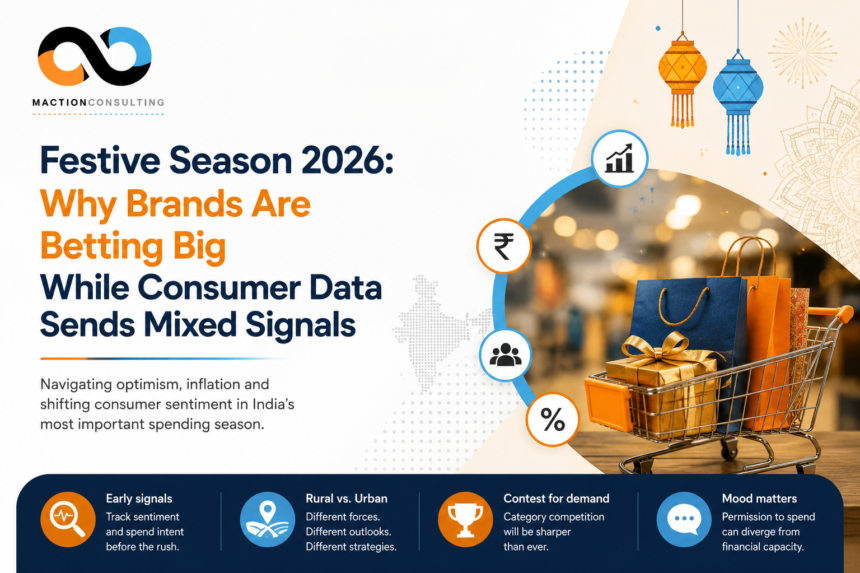
Industry commentary on this festive season is notably not treating it as a uniform story. Agency leaders quoted in recent trade coverage expect a genuine “contest for demand” rather than a rising tide that lifts every category — electronics, automobiles, home improvement, jewellery, and travel are expected to compete hardest for the pent-up discretionary spend, while FMCG and quick commerce are expected to anchor more routine festive spending rather than see a comparable surge. That’s a meaningfully different planning assumption than the aggregate 8-9% growth figures that dominate the headlines, and it’s the category-level split that should actually drive individual brand strategy.
Rural demand adds another layer of unevenness worth watching closely. Deloitte’s most recent outlook noted strong rural two-wheeler and tractor sales alongside FMCG growth outpacing urban FMCG growth in the past fiscal year — a genuinely healthy signal — but that same outlook explicitly flags rural demand as vulnerable to exactly the food-inflation and monsoon pressures now showing up in the CPI data. A brand with meaningful rural exposure planning festive inventory off last year’s rural strength risks missing a real shift already visible in the underlying numbers.
The Mood Matters as Much as the Math
One observation from agency planners is worth taking seriously in research design: festive spending isn’t purely a rational function of disposable income, it’s also about consumers giving themselves “permission” to spend, celebrate, and move on from a difficult stretch. That framing matters because it means purchase intent and financial capacity can genuinely diverge this year — a household might have less real headroom than last year but still spend close to last year’s level if the emotional pull of the season is strong enough, or the reverse could hold if inflation anxiety dominates the mood regardless of actual budget impact. Trackers measuring only stated purchase intent or planned budget miss this dynamic; consumer sentiment and ‘permission to spend’ indicators need to sit alongside the harder numbers.
What to Build Into Festive Research This Year
- Run a pre-season pulse check now, not just a post-mortem in November. With inflation actively accelerating through Q3, a category confidence and spend-intent read taken in July-August will be far more useful for inventory and marketing decisions than waiting for festive sales data to confirm the trend after the fact.
- Separate rural and urban demand readings explicitly, rather than reporting a single blended festive outlook — the two are being pulled by different forces this year (rural food/monsoon exposure vs. urban fuel and discretionary pressure).
- Track category-specific competitive intensity, not just category growth — with agencies expecting an unusually sharp “contest for demand” between categories, share of wallet may matter more than absolute category growth this festive season.
- Measure emotional readiness to spend alongside stated budget, since the “permission to spend” dynamic can cause actual behaviour to diverge from what a standard intent question captures.
- Revisit assumptions built on last year’s GST-cut tailwind, since that boost is now anniversarying against a higher, still-rising inflation base rather than the unusually low base of the prior year.
Frequently Asked Questions
Q: How big is India’s festive season in terms of consumer spending?
The Onam-to-Diwali festive window typically delivers close to a third of annual sales for many consumer goods companies. Last year’s festive window between September 22 and October 21 saw spending rise approximately 8.5% year-on-year to roughly ₹6 lakh crore. The 2026 season is being planned with similar or higher production volumes — but against a meaningfully different inflation backdrop.
Q: What are the key risks to festive season 2026 demand in India?
Three risks stand out: retail inflation accelerating toward 5–6% by year-end across the festive window, driven by Strait of Hormuz-linked fuel costs and a weak monsoon; rural demand vulnerability to food inflation and monsoon pressure despite strong rural signals earlier in the year; and the possibility that the emotional “permission to spend” dynamic diverges from actual household budget capacity this year.
Q: Will rural or urban demand be stronger in festive season 2026?
The two are being pulled by different forces. Urban demand faces discretionary squeeze from fuel costs and broader inflation. Rural demand showed strong signals through FY2026 — two-wheeler and tractor sales, FMCG outpacing urban — but is now directly exposed to food inflation and monsoon pressure. A blended rural-urban outlook misses the divergence that matters most for category planning.
Q: What should brands measure before India’s festive season 2026?
Five priorities: a pre-season pulse check on category confidence and spend intent now, before inventory decisions are finalised; separate rural and urban demand readings; category-specific competitive intensity rather than just category growth; emotional readiness to spend alongside stated budget; and a reset of assumptions built on last year’s GST-cut tailwind, which is now anniversarying against a higher inflation base.
Planning for a Season That’s Harder to Read Than It Looks
Production lines ramping up 30% and ad budgets gearing up for a demand contest both suggest genuine confidence in this festive season. But that confidence is being built on a consumer environment that has shifted since the data supporting it was collected — inflation is climbing in real time, rural exposure to that inflation is uneven, and the emotional readiness to spend doesn’t always track the household budget line by line. Brands that treat this festive season as a repeat of last year’s numbers, rather than research it fresh against the current inflation and sentiment backdrop, are planning against data that’s already a few months stale by the time Diwali arrives.
If you need a fast pre-festive read on category demand, rural-urban divergence, or spend sentiment before finalising inventory and marketing plans, talk to our research team at Maction.