


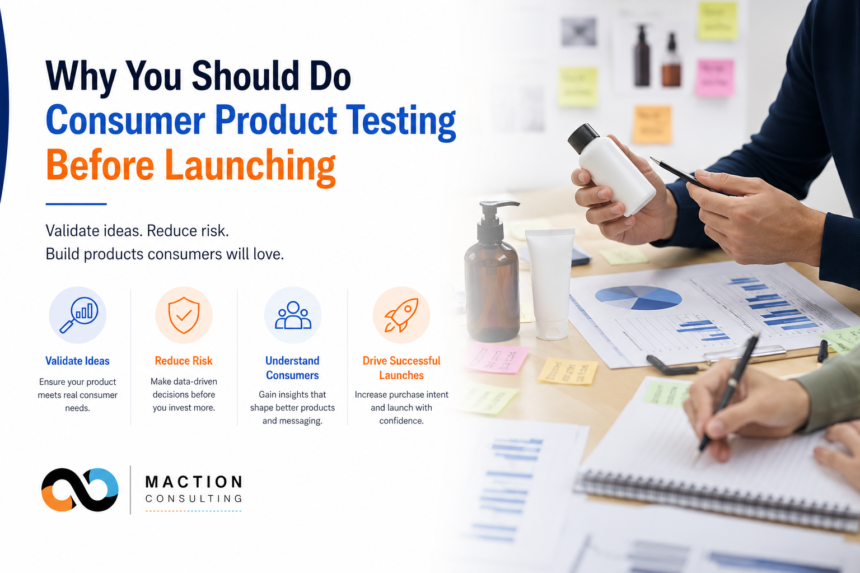
Consumer product testing is the step most brands skip — and the reason 70–80% of new products fail within their first year. Launching without it is one of the most expensive mistakes a business can make. Months of R&D, marketing investment, supply chain planning, and brand reputation all hinge on a single question: Will consumers actually buy it? Despite the stakes, studies consistently show that 70–80% of new consumer products fail within the first year. The most common reason isn’t poor design or weak marketing — it’s a fundamental disconnect between what the company built and what the consumer wanted.
This is precisely where consumer product testing becomes indispensable. By placing the product (or concept) in front of real target users before launch, brands can validate assumptions, refine features, optimize pricing, and uncover blind spots that internal teams almost always miss. It transforms a launch from a gamble into a calculated, evidence-led decision.
In a market where consumer expectations shift rapidly and competition is fierce, skipping pre-launch validation is no longer a defensible strategy. It’s a costly oversight.
The True Cost of Skipping Consumer Product Testing
When companies bypass pre-launch testing, the financial and reputational fallout can be severe. Failed launches don’t just waste manufacturing and marketing budgets — they erode retailer confidence, weaken brand equity, and create internal friction across teams.
Common consequences include:
- Excess inventory and markdown losses
- Negative early reviews that suppress future sales
- Costly reformulations or packaging redesigns post-launch
- Lost shelf space with key retail partners
- Damage to long-term brand trust
A relatively modest investment in pre-launch market research can prevent multi-million-dollar mistakes. It’s not an expense — it’s insurance.
What Consumer Product Testing Actually Measures
Strong product testing goes far beyond a simple “do you like it?” survey. A well-designed study evaluates the product across multiple dimensions that predict real-world performance.
Key areas include:
- Concept appeal: Does the idea resonate with the target audience?
- Purchase intent: Would consumers actually buy it, and at what price?
- Sensory and usage experience: Taste, texture, ease of use, durability
- Packaging and shelf impact: Visibility, clarity, emotional pull
- Competitive benchmarking: How it performs against existing alternatives
- Demographic and psychographic fit: Who responds best, and why
These insights help brands optimize the product, sharpen positioning, and prioritize the audiences most likely to convert.
How Pre-Launch Testing Strengthens Go-to-Market Strategy
Beyond validating the product itself, testing informs nearly every element of the launch plan. Marketing messages can be refined based on the language consumers use. Pricing strategies can be tested through methods like Van Westendorp or Gabor-Granger analysis. Channel strategies can be tailored based on where the target audience prefers to shop.
When new product validation is integrated into the launch process, teams move from intuition-based decisions to data-driven ones. This alignment between product, marketing, and sales dramatically improves launch outcomes and reduces internal disagreements about direction.
Case Study: A Beverage Brand Avoids a Costly Misstep
A mid-sized beverage company was preparing to launch a new functional drink targeted at health-conscious millennials. Internal teams were confident in the formulation and packaging. Before committing to full-scale production, the company commissioned a structured consumer product test involving central location tests (CLTs) and in-home usage tests (IHUTs) across three Indian metros — Mumbai, Bengaluru, and Delhi.
The results were eye-opening:
- 62% of respondents found the taste “too earthy”
- The packaging was perceived as “medicinal” rather than “refreshing”
- The price point was 18% higher than what consumers considered acceptable
Armed with these insights, the brand reformulated the flavor profile, redesigned the packaging with brighter visual cues, and adjusted pricing. When the product finally launched, it exceeded first-quarter sales targets by 34% — an outcome that would have been impossible without pre-launch testing.
Planning a product launch in India? Talk to Maction’s consumer research team about designing your pre-launch testing study →
Actionable Insights and Recommendations
To make consumer product testing a true competitive advantage, organizations should:
- Test early and often — concept stage, prototype stage, and pre-launch stage
- Use mixed methodologies — combine qualitative depth (focus groups, IDIs) with quantitative rigor (surveys, CLTs, IHUTs)
- Benchmark against competitors, not just internal expectations
- Segment results by demographics, usage occasions, and buyer personas
- Validate pricing separately from product performance
- Re-test after major changes to confirm improvements resonate
Treating testing as an ongoing discipline — not a one-time checkpoint — builds a culture of evidence-based innovation.
Frequently Asked Questions
When is the right time to start consumer product testing?
Ideally, testing begins at the concept stage, long before significant investment in production. Early-stage product concept testing helps identify whether the core idea has genuine market appeal. Subsequent rounds of testing then refine the prototype, packaging, pricing, and messaging as the product evolves toward launch.
How is consumer product testing different from a focus group?
A focus group is one qualitative method within the broader discipline of consumer product testing. Comprehensive testing combines qualitative tools like focus groups and in-depth interviews with quantitative methods such as large-scale surveys, central location tests, and in-home usage tests. This blend delivers both the “why” behind consumer reactions and the statistical confidence needed to make major business decisions.
How many consumers should be included in a product test?
Sample size depends on the methodology and decision being made. Qualitative studies typically involve 20–40 participants for directional insight, while quantitative tests generally require 200–400 respondents per segment to ensure statistically reliable results. The right sample plan should be designed around the target audience, geographic coverage, and the precision required for confident decision-making.
Is consumer product testing only useful for FMCG brands?
Not at all. While FMCG categories rely heavily on it, consumer insights from product testing are equally valuable for consumer electronics, personal care, financial products, digital services, automotive features, and even B2B offerings. Any organization launching something new to a defined audience benefits from validating fit, usability, and demand before going to market.
How Maction Can Help
At Maction Consulting, we help organizations de-risk product launches through rigorous, insight-driven consumer product testing. Our research teams design tailored studies — from concept screening and prototype evaluations to large-scale CLTs, IHUTs, and pricing research — across diverse consumer segments and geographies. Combining advanced survey design, qualitative depth, and powerful data analytics, we deliver actionable insights that help brands launch with confidence. Whether you’re refining a single SKU or planning a global rollout, our research and consulting expertise ensures your product is built around what consumers truly want.
The Takeaway
Consumer product testing is no longer optional — it’s a foundational element of any serious product launch strategy. It safeguards investment, sharpens decision-making, and significantly increases the probability of marketplace success. Brands that embed testing into their innovation pipeline don’t just avoid failure; they consistently outperform competitors who rely on assumption. In a marketplace driven by rapidly evolving consumer expectations, evidence wins.