





A fund manager, treasury desk, custodian, or regulated fintech function with vault accounts, policy-based approvals, granular access controls, audit trails, API access, and operational continuity when employees rotate.
That structure is reshaping how capital is allocated within DeFi, and it explains why Cardano’s latest infrastructure push via Iagon’s Cardano Vault, built with Fireblocks, is a bet on the operating model that serious capital actually requires.
Announced on May 8, the vault builds an enterprise control layer for Cardano-native operations comprising native assets, staking, reward withdrawals, and governance, inside a framework with vault accounts, controlled signing, approval workflows, and auditability that extends beyond a block explorer.
The vault layer
DeFi’s vault industry has consolidated around a three-tier structure consisting of protocols that provide the yield or liquidity rails, curators and risk managers that define mandates and risk limits for capital deployment, and distribution platforms that make the product usable for regulated capital.
Assets under management (AUM) across Morpho and Spark grew from $2.46 billion to $5.9 billion during 2025, and capital flowing into vault structures surpassed $6 billion last year.
Bitwise predicts on-chain vaults will double in AUM through 2026, framing them as “ETFs 2.0,” a product layer that abstracts complex on-chain mechanics into manageable, parameterized exposure.
RWA.xyz defines the core model as a smart contract allocation machine in which a risk manager or curator sets the strategy and parameters that govern how deposits move across isolated lending markets.
Gauntlet’s VaultBook frames vaults as non-custodial, transparent, and parameterized. They add that vaults are a critical integration layer for banks, fintechs, and payment providers moving on-chain.
The structural question both sources surface is which chains can fit inside a curator-led, risk-bounded, policy-enforced capital stack and deliver the auditability and workflow control that institutional risk teams demand.
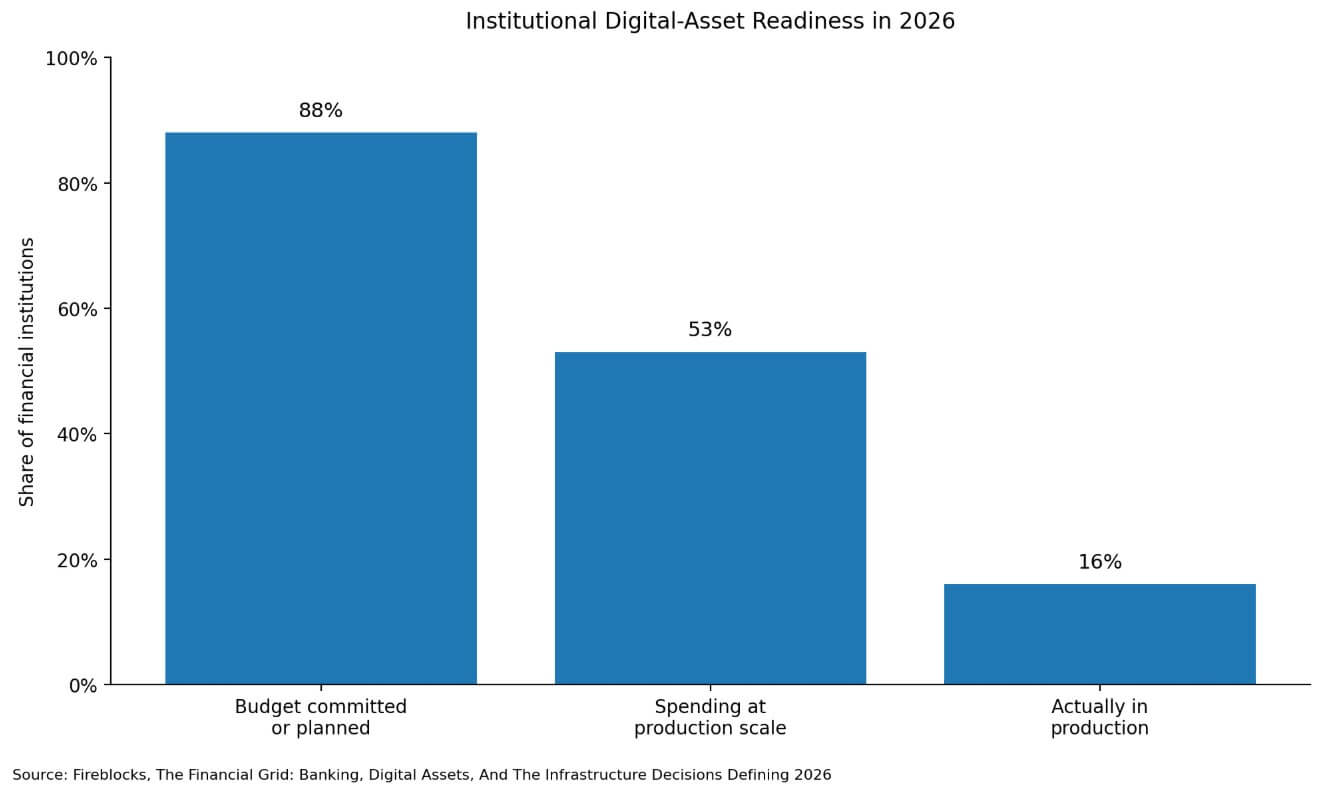
Fireblocks’ April 2026 survey found 88% of financial institutions have committed or will commit budget to digital-asset infrastructure this year, with 53% spending at production scale. Yet, only 16% have actually reached production.
Infrastructure positioning at this stage determines which chains are included in the next allocation cycle and which are bypassed.
Ethereum currently holds the deepest institutional vault infrastructure. Protocols like Morpho have established curated lending markets with risk manager-defined parameters.
Meanwhile, Solana’s lower latency and expanding institutional DEX volumes position it as the performance layer for active strategies.
A curator selecting a vault deployment in 2026 defaults to Ethereum or Solana first, then evaluates alternatives based on demonstrated liquidity depth, exit reliability, and audit completeness.
Cardano’s assembly
Cardano built its native feature set with staking, governance, native assets, and programmable tokens for individual users.
Delegation to stake pools, voting through DReps, and minting native assets function cleanly from a personal wallet.
An institution running a treasury or custodial operation requires workflow authorization, MPC-secured signing, approval routing across counterparties, and audit records that satisfy internal compliance requirements.
Cardano’s moves have focused on creating tools for these institutional needs over the last 60-75 days. USDCx went live on Cardano on Feb. 27, with Circle xReserve backing and CCTP-based cross-chain flows providing the stablecoin foundation that institutional workflows require.
The Cardano Foundation announced in March that integration with Archax allows tokenized assets to operate inside an established regulatory framework.
CIP-0113 introduced a programmable tokens framework that embeds compliance logic directly into native assets, enabling on-chain enforcement of rules at the asset level through native protocol logic. The new Cardano Vault adds the custody and operational control layer above all of that.
| Layer | Current component | Institutional function | Constraint / caveat |
|---|---|---|---|
| Stablecoin rail | USDCx | Settlement / treasury movement | Still limited scale |
| Regulatory wrapper | Archax integration | Tokenized assets in regulated framework | Early-stage relevance depends on usage |
| Compliance logic | CIP-0113 | Rules embedded at token level | Needs adoption by issuers/curators |
| Operational control | Cardano Vault + Fireblocks | Approvals, signing, auditability, workflow control | Must prove real production use |
| Market depth | Current Cardano DeFi base | Liquidity and exit reliability | Still modest vs ETH/SOL |
The vault model also opens an opportunity in staking.
Ethereum-based vaults primarily allocate capital to lending markets and liquidity pools, while Cardano’s proof-of-stake design continuously generates ADA staking rewards, without lockup periods or exposure to slashing.
A curator running a vault mandated to hold ADA with a defined yield floor can automate delegation, reward withdrawal, and reallocation inside Cardano Vault’s approval framework. This yield profile is different from what Ethereum or Solana vault operators offer.
CIP-0113 extends that logic to any native asset, allowing curators to embed eligibility rules and compliance triggers at the token level within the native protocol.
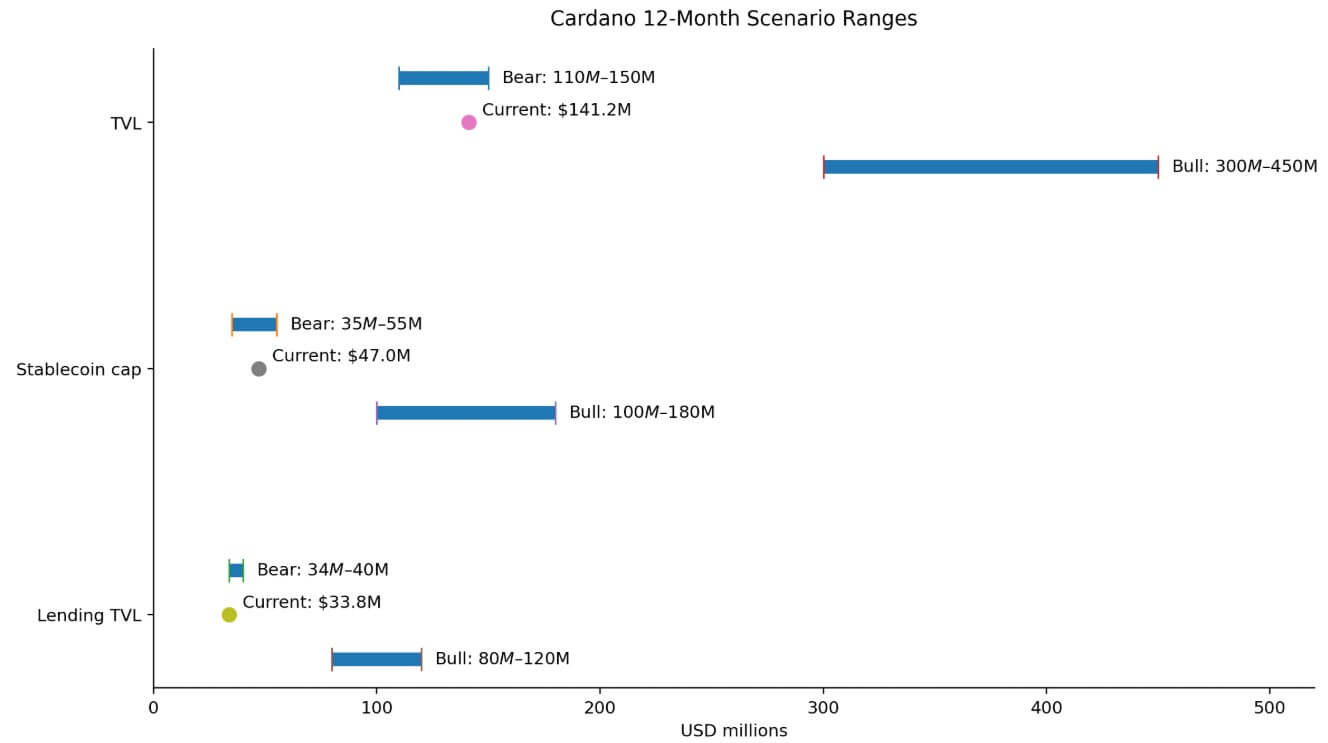
DefiLlama places Cardano’s total value locked (TVL) at approximately $141.2 million, stablecoin capitalization at nearly $47 million, and lending total value locked at $33.8 million. Those are modest numbers for an institutional-vault pitch, with seven-day DEX volume at $7.15 million, up 32.43% week over week.
The institutional infrastructure build is arriving before Cardano has institutional-scale on-chain depth, either reflecting a deliberate positioning or exposing a disconnect between announced rails and actual capital.
The open questions
The bull case requires USDCx, Archax, CIP-0113, and Cardano Vault to function as a coherent stack.
If real treasuries, custodians, or fintech applications run ADA, native assets, staking, and governance through Cardano Vault’s control environment, and a few deployments reach production, Cardano’s TVL could reach $300 million to $450 million within 12 months.
Stablecoin capitalization could also reach $100 million to $180 million, and lending TVL could reach $80 million to $120 million. The operative mechanism is curated capital entering through controlled institutional workflows, the model that drove the leading vault platforms from $2.46 billion to $5.9 billion in AUM through 2025.
The bear case is durable, with Fireblocks integrating with more than 150 blockchain networks, and Ethereum and Solana having deeper liquidity, longer institutional track records, and larger curator networks.
If Cardano Vault stays as a demo or a narrow custody extension, and Fireblocks’ institutional clients continue allocating through deeper ETH- and SOL-centered vault structures, Cardano TVL holds in the $110 million-$150 million range, stablecoins edge between $35 million and $55 million, and lending barely moves.
Bitwise noted that the October 2025 volatility spike hit poorly managed vault strategies and argued that institutional-grade risk management is becoming a baseline requirement for vault participation.
That is a standard that Cardano’s thinner liquidity base makes harder to meet in any scenario where curators prioritize depth and exit reliability over native-asset features.
DeFi’s institutional phase belongs to the chains that can be operated inside the vault, policy, and risk-control infrastructure institutions already use, which is the stack Fireblocks, Gauntlet, Archax, and similar players provide today.
Cardano Vault is the network’s bid to build enough institutional depth before allocation decisions consolidate around Ethereum and Solana.