


Affective computing enables Voice AI to recognize, interpret, and simulate human emotions, moving beyond rule-based responses to achieve emotional intelligence. By analyzing paralinguistic data such as pitch, rhythm, and intensity, modern systems decode the “how” behind speech. Leveraging advanced architectures like DistilHuBERT and Speech-to-Intent (S21) frameworks, Voice AI identifies discrete emotions and underlying communicative intents, fostering empathetic human-computer interaction.
When you snap at your smart speaker after a long day, it responds in the same flat tone it would use if you whispered a polite question. That gap between how humans communicate and how machines process speech is exactly what affective computing is working to close.
The answer lies in Speech Emotion Recognition (SER), a technology that teaches Voice AI to analyze paralinguistic data such as pitch, rhythm, and intensity to decode how a person is truly feeling. The goal is not just smarter machines. It is machines that genuinely adapt their behavior based on the emotional truth behind every spoken word.
The Shift from Literal to Emotional Machine Intelligence
Early voice systems were built to decode words, nothing more. The real evolution in AI is about teaching machines to understand the full spectrum of human communication, including the frustration in a clipped sentence or the warmth in a slow, steady tone.
This shift falls under the broader field of affective computing, which gives machines the ability to recognize, interpret, and respond to human emotional states. The goal is not to make AI seem more human for novelty’s sake; it is to build systems that genuinely adapt their behavior based on how a person is actually feeling.
Three distinct layers drive this intelligence. Emotion refers to an internal affective state, tone captures the paralinguistic cues that color spoken words, and intent describes the communicative purpose behind an utterance.
Real-World Stakes: Where Emotion AI Already Matters
Before diving into how these systems work, it helps to understand where they are already being deployed and why accuracy matters enormously in each context.
1. Automotive Safety:
A smart automotive assistant monitoring a drowsy driver cannot rely on what the driver says. It must detect the slowing speech rate, flattening pitch, and extended pauses that signal fatigue, and respond with a warning before an accident occurs. Companies like Cerence are already building this kind of fatigue-detection capability into in-car AI platforms.
2. Customer Service:
Call center AI platforms now flag emotional escalation in real time, alerting human agents when a customer’s tone shifts from frustration to genuine distress. This allows businesses to intervene before a conversation breaks down entirely.
3. Mental Health Support:
Therapy support tools use voice analysis to track mood patterns over time, giving clinicians a longitudinal picture of a patient’s emotional state that supplements what is captured in a weekly session. These applications require exceptionally rigorous audio annotation workflows to ensure the underlying models are trained on accurately labeled emotional data.
Decoding Tone: Why Paralinguistic Data Carries the Real Signal
Research in linguistics has long confirmed that the way something is said carries more emotional weight than the words themselves. Prosody, the rhythm, stress, and intonation of speech, is the channel through which emotional truth travels.
Modern Voice AI systems analyze several key acoustic parameters to extract this signal from paralinguistic data. Each parameter maps to a specific emotional dimension, making them critical training inputs for any robust SER pipeline.
Fundamental Frequency (F0): Tracking pitch variation allows models to identify states like excitement, fear, or sadness. A rising pitch at the end of a statement can indicate uncertainty even when the words suggest confidence.
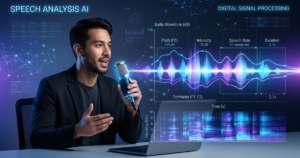
Intensity and Energy: Measuring the volume and energy of speech helps detect engagement levels or frustration. A person who gradually raises their voice mid-conversation is showing a signal that goes far beyond the literal content of what they are saying.
Speech Rate and Rhythm: Rapid speech often signals stress or urgency, while slower, deliberate speech typically reflects calm or sadness. These temporal cues are essential for distinguishing emotional categories that might otherwise look identical in text.
Bioinformational Dimensions: The “Size Code” hypothesis in vocal research proposes that pitch and vocal quality instinctively mimic body size signals. High-pitched, breathy voices project submissiveness, while low-pitched, tense voices project dominance, a layer of social meaning that purely text-based AI cannot access.
Categorizing Emotion: From Theory to Trainable AI Models
There are two dominant frameworks for teaching AI to classify emotional states in speech. Choosing the right one depends on the use case and the type of output the system needs to produce.
The Categorical Approach classifies speech into discrete emotional labels: happy, sad, angry, fearful, surprise, and disgust. These six categories, originally proposed by Paul Ekman, form the backbone of most commercial SER datasets and are commonly used in applications where a clear, actionable label is required.
The Continuous Dimensional Approach measures emotion along axes rather than in buckets. The two most common axes are valence, ranging from negative to positive, and arousal, ranging from calm to excited, which together can map a much richer and more nuanced emotional landscape.
A third, often-overlooked layer involves alterations in the autonomic nervous system. Involuntary physiological changes caused by strong emotion directly affect pitch range and vocal enunciation, and capturing these signals can significantly improve model accuracy in detecting high-stakes emotional states.
The data annotation process for training these models is itself a complex undertaking. Labeling speech with emotional categories requires annotators who understand both the acoustic signals and the contextual nuances of human expression. iMerit’s NLP data annotation services support exactly this kind of nuanced, high-precision labeling work.
Teaching Intent: The Technology of Speech-to-Intent (S2I)
Traditional voice AI pipelines convert speech to text, then analyze the text to infer intent. Speech-to-Intent (S2I) frameworks bypass this intermediate step entirely by extracting communicative intent directly from the audio signal.
This End-to-End (E2E) approach reduces latency and eliminates errors introduced by imperfect transcription. For emotionally charged or fast-paced speech, this matters enormously because inaccurate transcription can completely strip away the paralinguistic information that carries intent.
One powerful technique for building Speech-to-Intent systems is knowledge transfer from pre-trained text models. Acoustic embeddings can be guided by embeddings from large language models like BERT, allowing the audio model to leverage domain-specific semantic understanding that it could not learn from raw audio alone.
Data scarcity is a persistent challenge in S2I development, particularly for languages and dialects that lack large annotated corpora. Multi-speaker Text-to-Speech (TTS) synthesis is now widely used to generate synthetic training data, significantly expanding what models can learn in low-resource scenarios.
The Engine Room: Deep Learning Architectures Powering Speech Emotion Recognition
The performance gains seen in modern SER systems are a direct result of advances in deep learning architectures, particularly the shift from recurrent networks to transformer-based self-supervised models. Classical approaches using CNN-LSTM models remain useful baselines, but self-supervised learning from raw audio has fundamentally changed what is possible.
CNN-LSTM Models combine convolutional layers for capturing local spectral patterns with recurrent layers for modeling temporal dynamics. They remain computationally efficient and are still used in embedded applications where resources are constrained.
DistilHuBERT is a distilled, lightweight version of the HuBERT self-supervised model that delivers strong benchmark performance on SER tasks while significantly reducing computational overhead.
Wav2vec 2.0, developed by Meta AI Research, uses a contrastive self-supervised learning objective to build rich contextual representations directly from raw audio waveforms. It has become a foundational model for downstream tasks, including emotion recognition, speaker identification, and speech translation.
Multi-Task Learning (MTL) is one of the most promising deep learning architectures for emotion AI, jointly training models across several related tasks simultaneously. Training a single model to handle Speech Emotion Recognition, automatic speech recognition (ASR), and gender identification at the same time has been shown to boost performance on all three tasks compared to training each in isolation.
This article was written by the iMerit content team in collaboration with AI data specialists who have delivered speech annotation, NLP labeling, and multimodal data projects for enterprise clients across healthcare, automotive, and conversational AI. iMerit has built AI training data pipelines for Fortune 500 companies and AI-first organizations developing production-grade emotion and intent recognition systems. Our team draws on hands-on experience annotating thousands of hours of audio data across languages, dialects, and emotional contexts.
Sarcasm, Cultural Bias, and the Limits of Acoustic Analysis
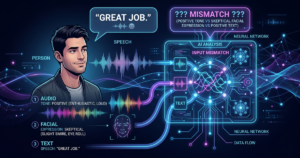
Sarcasm is where most emotion recognition systems break down. The defining feature of sarcastic speech is a deliberate mismatch between literal meaning and intended meaning, and resolving that mismatch requires more than acoustic analysis alone.
Multimodal fusion, combining audio, text, and visual cues where available, is the most promising direction for tackling sarcasm. When a model can see that a speaker’s facial expression contradicts their tone, or that their chosen words clash with their pitch pattern, it has a much better chance of correctly identifying the shift in sentiment.
Cultural bias presents an equally significant challenge. A model trained primarily on English-language data from Western contexts will systematically misinterpret paralinguistic data signals from speakers in other cultural contexts.
Respectful pauses that signal deference in some Asian communication styles, for instance, might be flagged as hesitation or uncertainty by a model trained without cultural diversity. Building culturally robust SER requires diverse and representative training datasets that reflect the full range of global human communication. This is why iMerit’s data collection services emphasize linguistic and demographic diversity at every stage of the pipeline.
Ethics, Privacy, and the Responsible Deployment of Emotion AI
Emotion-sensing systems operate on deeply personal data. The ethical obligations around their deployment are significant and are only beginning to be formalized in regulation and industry practice.
Transparency and Disclosure: Users interacting with emotionally responsive AI should always be informed that they are communicating with a machine. The risk of parasocial dependency, where users form emotionally significant relationships with AI systems without understanding their nature, is a well-documented concern in human-computer interaction research.
Privacy and Edge Computing: Emotional data extracted from voice is extraordinarily sensitive. Processing this data on-device rather than sending it to remote servers is rapidly becoming the privacy-first standard, particularly under GDPR and equivalent frameworks that treat inferred emotional states as a form of sensitive personal data.
Human-in-the-Loop Oversight: In high-stakes applications such as mental health monitoring or clinical support, AI emotion detection must function as a tool that augments human judgment rather than replacing it. Ensuring a qualified human reviews AI-flagged emotional signals before any consequential decision is made is a non-negotiable safeguard.
The annotation workflows used to train these systems also carry ethical weight. Annotators who label emotionally charged speech data must do so under conditions that protect their own well-being and ensure consistency in how sensitive emotional content is interpreted and classified. iMerit’s approach to responsible AI data operations is built around exactly these principles.
The Future of Empathetic Voice AI
The trajectory of Voice AI points toward systems that function less like tools and more like collaborative partners. Proactive AI agents capable of monitoring team communication patterns, detecting early signs of disengagement or burnout, and offering timely support represent a genuinely near-term possibility rather than science fiction.
The paralinguistic data layer, the pitch, rhythm, energy, and timing of human speech, is the heartbeat of authentic communication. Teaching machines to hear it accurately is not just a technical challenge. It is the foundational work that will determine whether the next generation of AI feels like a genuine extension of human intelligence or simply a faster, more elaborate text processor.
For teams building SER datasets, voice annotation pipelines, or NLP training data at scale, iMerit’s AI data solutions provide the expert annotation and quality infrastructure these systems require.
Frequently Asked Questions
What is affective computing in Voice AI?
Affective computing is a field that gives machines the ability to recognize, interpret, and respond to human emotional states. Instead of just decoding literal words, these systems aim to bridge the gap between human communication and machine processing by adapting their behavior based on how a user is actually feeling.
How does AI detect emotion and tone from a voice?
AI systems analyze paralinguistic data, which refers to how something is said rather than the words used. Key parameters include Fundamental Frequency (F0) for tracking pitch, Intensity and Energy for measuring volume, and Speech Rate and Rhythm for using temporal cues to distinguish between states like stress, calm, and sadness.
What is the difference between tone and intent in AI?
Tone and intent represent different layers of communication intelligence. Tone captures the paralinguistic cues, including rhythm, stress, and intonation that color spoken words, while intent describes the communicative purpose or the “why” behind what a person is saying. Modern Speech-to-Intent frameworks extract this purpose directly from audio to avoid losing nuance during text transcription.
Can Voice AI understand sarcasm?
Sarcasm is one of the most difficult challenges for AI because it involves a deliberate mismatch between literal meaning and intended tone. Developers use multimodal fusion, combining audio, text, and visual cues like facial expressions, to help the model identify a shift in sentiment that acoustic analysis alone would miss.
How does cultural bias affect Speech Emotion Recognition?
Emotional norms vary significantly across the globe. A model trained primarily on Western data might incorrectly flag respectful pauses common in some Asian communication styles as hesitation or uncertainty. Building accurate systems requires diverse and representative training datasets that reflect global communication styles.
Is emotional voice data protected under privacy law?
Under frameworks like GDPR, inferred emotional states are treated as sensitive personal data. To protect user privacy, the industry is increasingly moving toward edge computing, where emotional data is processed directly on the device rather than being transmitted to remote servers.
How are AI models trained to recognize emotions in speech?
Models are typically trained using two frameworks. The Categorical Approach classifies speech into discrete labels like happy, sad, or angry, while the Continuous Dimensional Approach measures emotions along axes such as valence and arousal. Both frameworks require expert human annotation to label speech with acoustic signals and contextual nuances accurately.