



Artificial intelligence (AI) models often struggle when deployed across languages and regions. Most large language models (LLMs) are primarily trained on English text and fail to account for diverse cultural contexts, often defaulting to Western cultural values and idioms.
Businesses expanding globally find their AI applications perform well only in Western contexts and not reliably elsewhere.
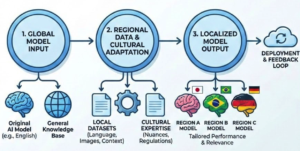
A fix for this problem is model localization services, customizing AI models for specific languages, dialects, and cultures. It combines local text corpora, culturally relevant examples, and region-specific rules to produce AI models that feel natural to local users.
In this article, we will explore model localization, how it works, and its business benefits and challenges. We will also examine how iMerit delivers expert-driven localization services to help organizations build trustworthy global AI.
What Is Model Localization?
Model localization is a process of refining a pre-trained AI model, so its outputs align with the expectations of a specific locale. This is done through retraining or fine-tuning that adjusts the model’s internal logic.
Model localization services typically involve three layers of adaptation.
Linguistic Adaptation
First is the linguistic layer, where the model learns to understand regional dialects, colloquialisms, and code-switching patterns (mixing languages). Models trained primarily on English or formal text often struggle with mixed-language queries or informal speech. Localization addresses this by training on native data rather than translated content.
Cultural Alignment
At the cultural layer, the model adjusts its reasoning to match local values, humor, taboos, and social norms. Model localization helps set the right tone, politeness levels, and handling of sensitive topics so that outputs feel appropriate and respectful. This cultural alignment reduces bias and prevents culturally misaligned responses.
Regulatory and Compliance Alignment
The third layer is the regulatory layer, where the model adheres to local data protection laws, sovereignty requirements, and industry-specific rules. It includes compliance with privacy frameworks, healthcare standards, financial regulations, and emerging AI laws. Localization services ensure that model training data, deployment workflows, and documentation meet regional legal requirements from the start.
How Model Localization Services Work
Localization is a multi-step process combining data preparation, model tuning, automation, and human expertise.
Data Curation
The localization process begins by gathering high-quality local content. That includes publicly available text (news articles, books, web forums), domain-specific documents (like legal codes or medical journals), and even regional social media.
Native data ensures the model learns how people actually use the language rather than relying on translated English text.
This gathered content is also filtered and annotated to remove errors or culturally inappropriate examples. The curated dataset is then used to prime the model’s knowledge of local realities.
SFT (Supervised Fine-Tuning)
Supervised fine-tuning is the stage where the model is trained on high-quality question-and-answer (Q&A) pairs written by native speakers.
These speakers are domain experts who understand the professional and social context of the target region. SFT teaches the model how to respond in a way that is both linguistically accurate and contextually appropriate for the local market.
Reinforcement Learning from Human Feedback (RLHF) with Local Annotators
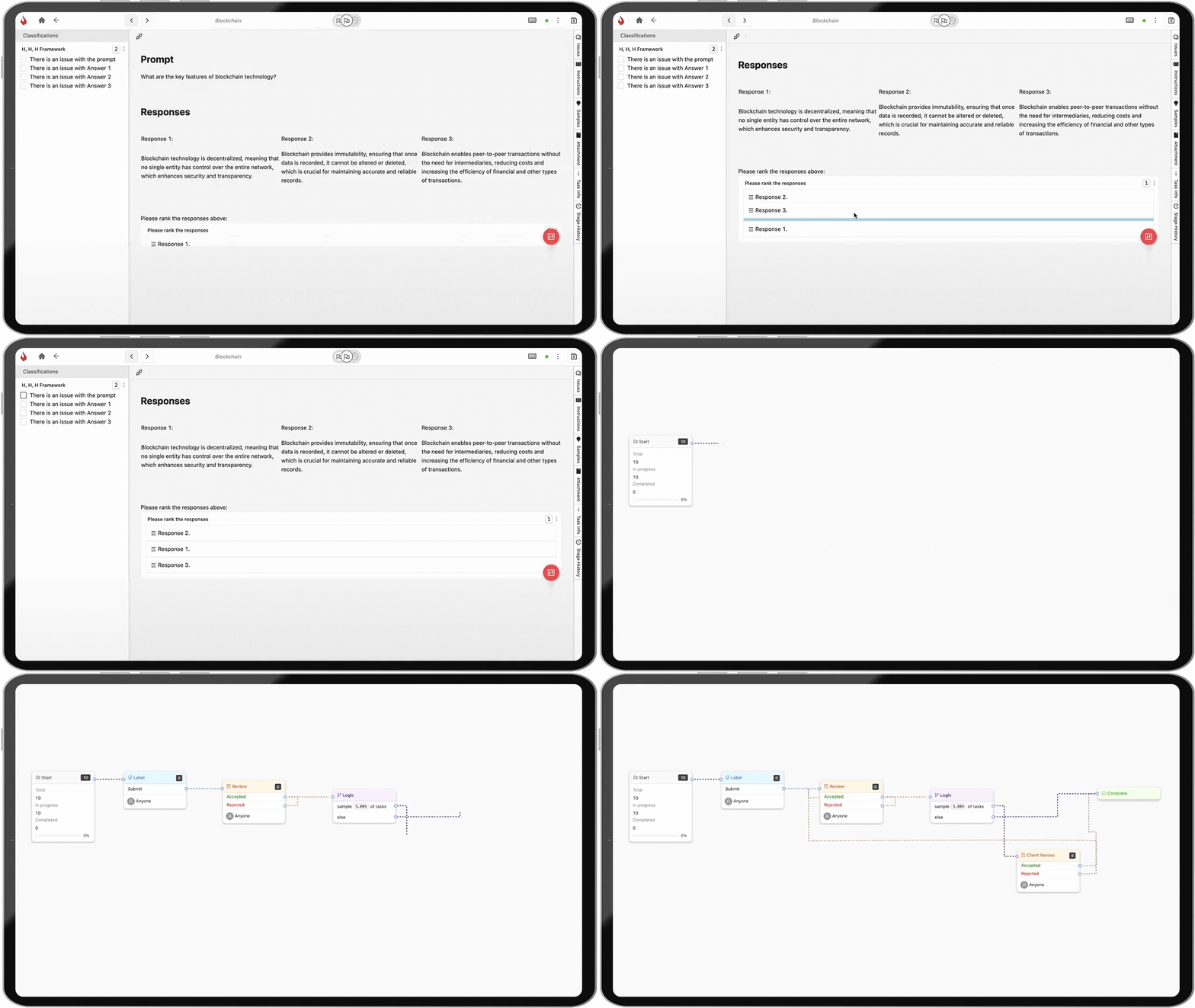
After fine-tuning, RLHF further refines the model. RLHF involves using human feedback in the target region to rate and rank model responses. In localization services, cultural standards vary, so a local rater’s feedback is crucial.
By training a reward model on regional preferences, organizations can ensure that the final model behavior aligns with local values.
Red Teaming for Culture
In addition to training, cultural red-teaming is a proactive safety measure where local teams try to trick the model into generating harmful or biased content using regional context.
It includes testing the model under localized stress conditions, such as prompts involving regional political crises or sensitive social happenings.
Companies mitigate reputational risk by identifying these vulnerabilities before the model is released.
Benefits and Business Impact of AI Model Localization
Investing in model localization services is a strategic business decision that directly impacts market success and user trust. Benefits include:
- Market expansion and user trust: Localized AI models support faster entry into new markets. When AI responds in the local language and reflects cultural norms, users trust it more. This increases adoption, engagement, and customer satisfaction.
- Reduced risk (legal, reputational, bias-related): Model localization services align AI models with local laws, cultural expectations, and safety standards. This reduces the risk of regulatory penalties, public backlash, and biased or inappropriate outputs.
- Better performance and engagement in non-English: AI models fine-tuned on native data perform more accurately in local contexts. This improves response quality and user engagement outside English-dominant markets.
- Competitive advantage in regulated or culturally diverse regions: Businesses using localized AI models can better meet regional expectations and compliance requirements and create a stronger market position.
- Cost and speed gains vs. building region-specific models from scratch: Localization lets organizations adapt existing AI models instead of building separate models for every country or language.
Challenges and Limitations
Despite its importance, AI model localization poses several significant challenges that organizations must overcome.
- Scarcity of high-quality data for low-resource languages and cultures: Many languages lack sufficient native training data. Collecting and validating high-quality, culturally accurate datasets is time-intensive and resource-heavy.
- High cost and computing demands of fine-tuning and alignment: Localizing AI models across multiple regions requires more investment in model training, compute, and expert human oversight.
- Difficulty objectively measuring cultural fit and success: Cultural appropriateness is subjective. Unlike technical accuracy, it is harder to define clear metrics for tone, nuance, and social alignment.
- Risk of over-localization or losing global consistency: Excessive regional customization can create fragmented model behavior and reduce consistency across markets.
- Changing regulations create moving targets: Data protection laws and AI regulations keep changing, so model localization services require ongoing updates to maintain compliance.
How iMerit Solves the Challenge and Delivers High-Quality Model Localization Services
Model localization depends on high-quality, context-aware data and expert human input to ensure model behavior aligns with local expectations. At iMerit, we combine elite human expertise with advanced technology to deliver quality training data for global AI projects.
Global, Culturally Attuned Workforce
We build multi-lingual teams worldwide. Our Scholars platform connects experts from target region (10,000+ resources across 60+ countries) with native language and domain experts.
Multilingual and Multimodal Data Expertise
iMerit supports dozens of languages and content types. Our teams annotate and fine-tune diverse data types, including text, image, audio, video, and sensor data.
Examples of our data services include:
- Image and Video Annotation: Labeled data for computer vision tasks in medical AI, autonomous technology, and geospatial intelligence.
- Audio Transcription and Speech Annotation: Speech-to-text services that capture regional accents, dialects, and domain terminology for training localized voice and conversational AI systems.
- Text Annotation for NLP: Named entity recognition (NER), sentiment analysis, intent classification, and semantic labeling to improve multilingual language models and localized AI responses.
- Human Feedback and RLHF Workflows: Expert evaluation and ranking of model outputs to align AI behavior with region-specific expectations and safety standards.
- Document Processing and Data Extraction: Structuring information from local documents, reports, and forms to enrich training datasets with region-specific knowledge.
- Corpus Augmentation: Expanding datasets with high-quality, relevant data for low-resource languages.
Cultural Nuance and Region-Specific Adaptation
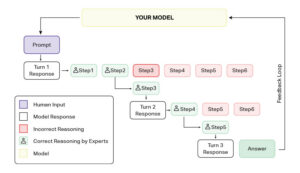
We at iMerit utilize the Ango Deep Reasoning Lab (DRL) to support structured model tuning and evaluation. The platform allows experts to analyze model reasoning step by step using techniques such as Chain of Thought reasoning and ensure the AI learns the complex logic required for accurate localized responses. Alongside this, our red teaming for culture service probes models for regional biases by testing them with diverse inputs across specific cultural and social contexts.
Compliance and Regulatory-Ready Workflows
iMerit provides reliable and secure solutions for model localization, particularly for highly regulated sectors. Our Ango Hub platform automates the human-in-the-loop process with strong security and quality control. The workflows adhere to global compliance standards, including HIPAA, SOC-2, and GDPR. Furthermore, iMerit’s Audit and Quality Control services ensure that generative AI outputs are safe, accurate, and ready for deployment in the global market.
Case study: Fine-Tuning a 10-Language LLM
A conversational AI company needed to localize its LLM for specific regions (English, Hindi, Bengali) to ensure safety and cultural relevance.
iMerit assembled an 80-expert team of linguists, social scientists, and prompt engineers who generated 60,000 culturally sensitive prompt-response pairs, incorporating regional norms and code-switching patterns.
The localized model was released to widespread acclaim, resulting in a growing user base and helping the company secure an additional $50 million in funding.
Conclusion
Model localization services are a necessity, as without them, even the most advanced AI models will underperform or misfire in new regions. By addressing linguistic shifts, cultural nuances, and regional compliance needs, organizations can transform a generic foundation model into a context-aware local assistant. Companies that invest in model localization gain wider reach, stronger user trust, and lower risk.
Contact our experts today to scale your AI models globally with precision, cultural alignment, and regulatory confidence.