



Many AI projects stumble not because of flawed models, but because of the data they’re built on. Yet most enterprises spend more time evaluating models than the vendors who create their training data. Enterprises are discovering that their biggest AI risks often start with their data partners. iMerit has worked with organizations that uncovered systematic labeling errors in production datasets, triggering costly project delays, compliance reviews, and vendor transitions.
These are not rare problems. That’s why evaluating AI data vendors with the same rigor applied to model selection has become critical for enterprise AI success. AI vendor selection decisions made without proper vendor due diligence can expose organizations to compliance risks, quality failures, and costly rework.
- A widely cited study in Science (Obermeyer et al.) found that a commonly used U.S. healthcare algorithm underestimated the medical needs of Black patients because it used healthcare spending as a proxy for illness severity.
- Industry reporting has also highlighted how poor dataset provenance and unethical data collection practices can create costly setbacks for high-stakes AI programs. For example, computer vision datasets built from improperly sourced or non-consensual imagery often require retraining, legal reviews, and compliance delays.
- In one autonomous systems project, audit teams found that 33% of images with annotation errors, including unlabeled vehicles and pedestrians, highlighting the risks of weak data vendor workflows.
These are not edge cases. They are preventable failures rooted in inadequate vendor evaluation. AI systems are only as reliable as the data they learn from, yet vendor selection in this space often lacks the same rigor applied to model evaluation itself.
This blog discusses a practical framework for assessing AI data vendors across three pillars: Safety, Trust, and Quality, so teams can make confident choices and build dependable systems.
The New Standard for AI Data Vendor Evaluation
As AI regulation tightens and enterprise risk increases, buyers are expected to move beyond cost and speed as key decision-making factors. Frameworks such as the NIST AI Risk Management Framework (AI RMF) and the EU AI Act emphasize data governance, transparency, and accountability. This means organizations must evaluate data vendors not just on their ability to label or supply data, but on how well they manage risk, ensure safety, and maintain quality across the AI lifecycle.
In other words, a reliable data partner doesn’t just provide datasets; they provide confidence. That’s why data vendor assessment frameworks have become essential tools for enterprise AI teams navigating AI data procurement decisions.
Safety: Mitigating AI Risks Before They Scale
Safety starts with preventing harm to users, systems, and the public. Safety begins long before a model is trained. The right vendor will have strong policies for data sourcing, privacy, and workforce oversight to prevent harmful or non-compliant data from entering your pipelines. When evaluating AI data vendors for safety, examine their risk management policies, adversarial testing capabilities, and infrastructure security. A dependable AI data vendor should also demonstrate clear governance for managing risks related to bias, security, and adversarial inputs.
What to look for:
- Documented risk management and data provenance policies aligned with NIST AI RMF or ISO 27001.
- Adversarial testing and red-teaming processes that detect vulnerabilities in training data or labeling workflows.
- Human-in-the-loop oversight, ensuring sensitive edge cases are reviewed by expert annotators.
- Secure infrastructure (ISO 27001, SOC Type 2) and defined incident response timelines.
- Robust workforce security, including training, background checks, and access controls
Questions to Ask Vendors: Can you share examples of how your teams identify and address data risks before they reach production models?
Real-World Example:
A logistics company discovered that its autonomous-vehicle vendor had used publicly scraped images that included children’s faces. The dataset violated GDPR and had to be discarded entirely. A vendor with proper safety governance would have flagged these assets before collection. This incident highlights why vendor due diligence on data sourcing practices is non-negotiable in regulated industries.
Trust: Transparency and Governance You Can Verify
Trust is built on transparency – how well a vendor documents data sources, labeling processes, and model evaluation results. Evaluating AI data vendors for trustworthiness means verifying their transparency through comprehensive documentation and audit trails.

Leading frameworks, such as Datasheets for Datasets and Model Cards, have become the industry standard for documenting the origin, use, and limitations of datasets and AI models. A trustworthy vendor should provide documentation and audit trails that make every decision traceable throughout the dataset lifecycle.
What to Look For:
- Comprehensive dataset documentation (Datasheets, Model Cards, etc) for every dataset, detailing collection methods, sampling, consent, and known skews.
- Model cards for any automated pre-labeling tools, including subgroup performance metrics.
- Compliance alignment with emerging regulations such as the EU AI Act (Article 10) on data quality and governance.
- Audit readiness, including traceable metadata, data lineage documentation, and version control across datasets.
- Full annotation audit trails
- Clear policies for data retention and deletion
- Third-party audits and compliance reports
Questions to Ask vendors:
- Can you provide dataset documentation or a sample audit log?
- What’s your policy for data deletion after project completion?
- How do you document dataset provenance and maintain audit trails across revisions?
Real-World Example: A financial services company preparing for an EU AI Act audit discovered its vendor couldn’t produce annotation audit trails for datasets collected 18 months earlier. The company had to re-annotate critical data to meet compliance deadlines, delaying deployment by three quarters. Proper data vendor assessment during the AI vendor selection phase could have prevented this costly oversight.
Measuring the Accuracy and Consistency That Drive Performance
Model performance depends on the consistency and diversity of its training data. Evaluating AI data vendors on quality requires examining both their accuracy metrics and validation processes. True data quality goes beyond accuracy; it reflects how well data captures real-world diversity and remains reliable across edge cases. Achieving that level of quality requires defined metrics, rigorous validation, and continuous feedback loops between annotators, reviewers, and clients to maintain alignment and precision throughout the labeling process.
High-quality data results from three core foundations: process, people, and technology.
Strong processes ensure consistency through multi-step review cycles, gold-standard validation sets, sampling-based audits, and versioned annotation guidelines. Skilled annotators and domain experts provide the human judgment needed to correctly interpret complex cases, maintain consistency, and resolve edge-case ambiguity.
Modern technology reinforces these systems through automated QA checks, rule-based validations, consensus workflows, real-time quality dashboards, and audit trails that ensure traceability across the entire dataset lifecycle. Together, these elements form the infrastructure that enables reliable, production-grade data quality.
What to Look For:
- Inter-annotator agreement (IAA) metrics (Cohen’s, Fleiss’, or Krippendorff’s) to measure labeling consistency
- Gold-standard validation sets and continuous sampling-based audits.
- Defined multi-tier QA workflows, combining automation with expert review.
- Continuous monitoring for data drift, bias, and imbalance
- Workforce management transparency, including training programs and qualification tracking.
Questions to Ask vendors:
- What KPIs do you track to measure annotation accuracy and consistency?
- Can you provide a recent example of how your QA process improved dataset performance?
Real-World Example: A vision AI vendor failed an enterprise pilot when model accuracy dropped 20% post-deployment. The issue traced back to inconsistent labeling definitions across regions, something transparent QA metrics could have caught early.
The Role of High-Quality Data Labeling
High-performing AI systems depend on how well their training data is labeled. Even with advances in automation and pre-labeling tools, human-guided labeling remains essential for handling ambiguity, interpreting context, and making the fine-grained distinctions models learn from. Evaluating a vendor’s data labeling maturity means looking at how they design and maintain guidelines, how they calibrate teams, and how consistently they enforce review cycles across complex projects.
Vendors with strong labeling operations treat it as a disciplined process, not a one-off task. They rely on well-defined workflows, multi-step reviews, consensus mechanisms, gold-standard references, and documented evolutions of taxonomies. To ensure this rigor is measurable, vendors should also define explicit quality metrics and SLAs such as accuracy thresholds, turnaround times for corrections, minimum inter-annotator agreement (IAA) scores, and sampling-based audit frequencies so enterprises know exactly what level of performance to expect and how it will be enforced.
Physical Data Operations & Secure Handling
Many enterprise AI programs rely on sensitive, regulated, or physical data assets, not just digital image or text files. Healthcare scans, robotics sensor logs, automotive video, financial records, and proprietary enterprise datasets require secure environments with strict controls. Vendor evaluation today must include assessing how data flows physically and operationally across their systems.
Beyond security controls, buyers should also evaluate the vendor’s process for acquiring, ingesting, and preparing physical data, such as chain-of-custody procedures during on-site data capture, secure transport mechanisms, calibration steps for sensor-based recordings, and standardized workflows for digitizing or anonymizing physical assets before annotation. A mature vendor demonstrates operational discipline not only in safeguarding data but also in collecting it consistently and accurately.
A mature data vendor can demonstrate controlled access, chain-of-custody documentation, retention and deletion governance, and infrastructure aligned with compliance requirements such as HIPAA, GDPR, SOC 2, and ISO 27001. Their workflows should prevent unauthorized duplication, ensure secure ingestion, and maintain traceability from the moment data enters their environment until its lifecycle is complete. For high-stakes domains, strong physical data operations aren’t optional; they are core to risk management.
Human Expertise & Skilled Annotators
Even with synthetic augmentation and automated QA, human expertise remains central to reliable data quality. Skilled annotators interpret nuance, apply domain knowledge, and navigate edge cases that automated systems routinely miss. For safety-critical sectors, healthcare, autonomous mobility, finance, and geospatial intelligence, the presence of trained specialists directly impacts model performance and downstream outcomes.
A credible vendor maintains a stable, trained workforce supported by structured onboarding, continuous upskilling, and SME-driven guidance for complex workflows. Evaluating vendors means understanding how they qualify annotators, sustain team consistency, and ensure that domain knowledge is applied uniformly over time. Enterprises should also assess how quickly a vendor can scale expert capacity, whether through established recruitment pipelines, pre-qualified specialist pools, or rapid onboarding frameworks, when projects demand accelerated ramp-up or expansion. Human expertise is not a commodity layer; it is a strategic pillar of trustworthy AI development.
Evaluating Synthetic Data Capabilities
Synthetic data has quickly become an important tool for overcoming data scarcity, addressing privacy constraints, and filling coverage gaps, especially for rare or safety-critical scenarios. When evaluated correctly, synthetic data can help teams expand datasets, simulate edge cases, and balance distributions without exposing sensitive information.
However, not all synthetic data pipelines are equal. Vendor evaluation should focus on how synthetic data is generated, validated, and integrated. Strong systems maintain statistical fidelity to real-world distributions, document generation methods, version the outputs, and continuously test model performance with and without synthetic augmentation. In enterprise settings, synthetic data should enhance, not replace, real-world data, serving as a strategic complement to strengthen robustness and reduce risk.
Building a Vendor Evaluation Checklist
| Category | Key Criteria | What to Request | Priority |
|---|---|---|---|
| Safety | Risk management policies, adversarial testing, and secure infrastructure | NIST-aligned docs; ISO 27001; SOC 2 | Critical |
| Trust | Datasheets; model cards; audit trails; data lineage | Sample documentation; compliance reports | Critical |
| Quality | IAA metrics; QA workflows; gold-set validation | IAA reports, QA SOPs, performance dashboards | Critical |
| Governance | SLAs, right to audit, data deletion policies | Legal terms, remediation playbooks, and accountability framework | High |
Detecting Fail Points: Knowing When to Exit a Risky AI Partnership/Exit Indicators:
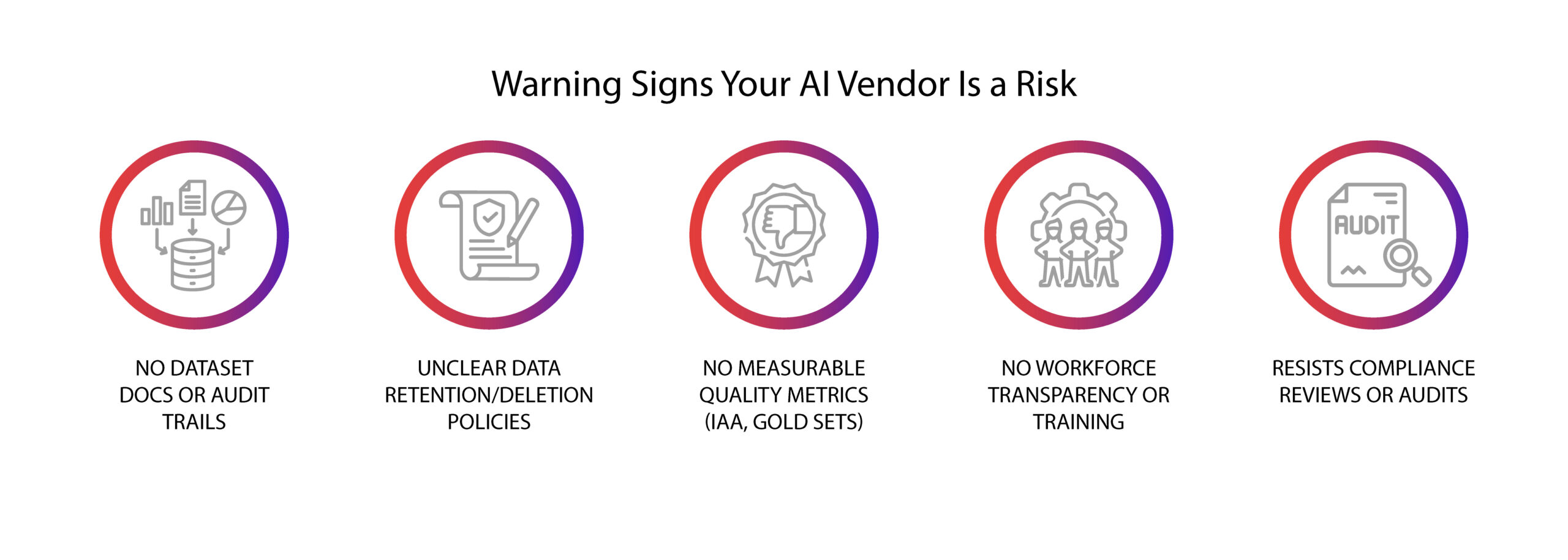
When Your AI Vendor Becomes a Liability. Even experienced teams can overlook warning signs. Watch for vendors who:
- Cannot provide dataset documentation or audit trails
- Have vague or missing data retention and deletion policies
- Lack measurable quality metrics (IAA, gold-set validation)
- Lack of workforce transparency or annotator training programs
- Resist compliance reviews or third-party audits
How to Evaluate Governance: The Framework That Ensures Accountability
Even excellent processes need contractual and procedural safeguards. Strong governance ensures that vendor responsibilities, SLAs, and escalation procedures are clearly defined.
What to Look For:
- Contractual rights to audit and inspect data practices
- Clear SLAs for delivery, accuracy, and security
- Enforceable remediation and incident response plans
Real-World Example: A government agency discovered that its data labeling vendor retained sensitive project data beyond the contract term for “internal training purposes,” creating compliance and reputational risk.
Why It Matters More Than Ever
AI regulation and governance expectations are accelerating globally. From the EU AI Act to sectoral frameworks like HIPAA and MDR in healthcare, enterprises are now accountable for the data supply chains behind their AI models. Vendor transparency isn’t optional anymore; it’s part of AI compliance, safety, and brand reputation.

Key developments shaping compliance expectations:
With EU AI Act enforcement already underway and U.S. federal assessments in progress, enterprises now face a narrowing readiness window to document data provenance and vendor compliance or risk financial penalties and reputational damage. Organizations engaged in AI data procurement must now factor regulatory compliance into every AI vendor selection decision.
Why iMerit
With over a decade of experience supporting Fortune 500 companies and research institutions across regulated healthcare AI, autonomous systems, and other high-stakes domains, iMerit provides enterprises with a trusted foundation for AI data excellence.
iMerit’s Ango Hub + iMerit Scholars enable teams to:
- Trace every annotation decision with immutable audit logs (meets EU AI Act Article 10 requirements)
- Automate a significant portion of QA checks while reserving human review for edge cases
- Validate datasets against gold standards and detect performance drift.
- Maintain SOC 2 Type II and ISO 27001 compliance across global operations
Enterprises leveraging Ango Hub and iMerit’s domain experts have reported faster deployment timelines and reduced post-launch model failure rates compared to previous vendor partnerships.
In healthcare AI, iMerit supported a leading conversational AI company in building HIPAA-compliant training data for clinical documentation, helping doctors save 12 hours per week and reduce burnout by 43%. Read the full case study.
Conclusion: Building Safer AI Partnerships Starts with Due Diligence
Selecting the right AI data vendor is not just a procurement decision; it is a trust decision. As regulations tighten and model risks become more visible, enterprises need vendors that go beyond technical delivery to demonstrate verifiable safety, transparency, and governance maturity.
By applying the evaluation framework shared above: assessing safety protocols, audit transparency, quality workflows, and governance readiness, organizations can confidently filter vendors who align with their risk, compliance, and innovation goals. Robust vendor due diligence practices and systematic data vendor assessment methodologies are now essential components of responsible AI data procurement.
Experience across global enterprises shows that reliable AI depends on expert-vetted data and transparent annotation pipelines. iMerit brings this approach to high-stakes AI programs through Ango Hub, its data annotation and quality-management platform with built-in auditability and governance controls, paired with the domain expertise of iMerit Scholars, a network of highly skilled data specialists. Organizations using this combined structure have reported faster deployment cycles and lower post-launch model failure rates compared to previous vendor relationships.