


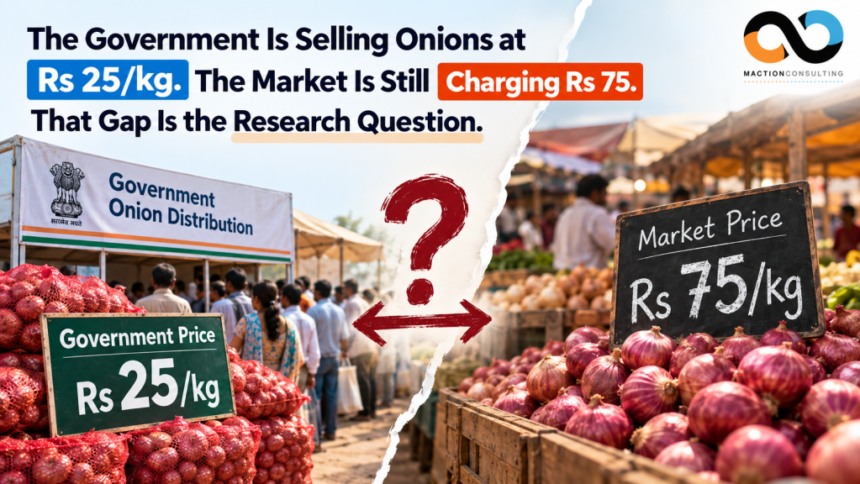
The Centre’s onion buffer-stock intervention, flagged as a plan back in July, is now visibly running: roughly 4,000 tonnes sold across 17 cities in the intervention’s first ten days, moved via wholesale markets, cooperative outlets, and a dedicated rail service nicknamed the “Kanda Express.” A fresh consignment reached Kolkata this week as part of the effort. The subsidised rate on offer is around Rs 25 per kg. Open-market retail prices in several cities are still running well above that — Delhi’s average has been quoted as high as Rs 75 per kg this season. A Rs 50 gap between the subsidised price and the street price, sustained even after weeks of active intervention, is the more interesting number here than either price on its own.
What This Follows Up On
Onion inflation has been a recurring thread in India’s food-price story through this year, and it was flagged specifically as a festive-season risk in the Retailers Association of India’s latest survey, which noted all-India onion prices up over 22% year-on-year by mid-July and cited a planned government buffer release as the response. That release is now underway, roughly on the September timeline originally announced, targeting the Durga Puja-through-December high-consumption window. The intervention is real and reasonably fast-moving — the question worth researching now isn’t whether the government acted, but whether the intervention is actually reaching the consumer’s basket at the scale the price gap suggests it should.
Why a Well-Designed Intervention Can Still Leave a Large Price Gap
A subsidised-price gap of this size, persisting weeks into an active intervention, usually comes down to one or more of a few mechanisms, and distinguishing between them matters for anyone trying to forecast how food-price pressure evolves through the festive season:
- Volume versus market size. 4,000 tonnes across 17 cities, against total national onion consumption running into millions of tonnes annually, is a genuinely small share of the market — a subsidised channel can be running smoothly and still not be large enough to move the average retail price much on its own.
- Channel awareness and access. Subsidised onions sold through NCCF and NAFED outlets, cooperative stores, and mobile vans require a consumer to know the outlet exists, be able to reach it, and be willing to queue or travel for it — frictions that don’t apply to buying from the nearest vegetable vendor at the market rate.
- Wholesale-to-retail pass-through lag. Even where buffer stock does reach wholesale markets and pushes mandi prices down, local retailers don’t always pass that through to the counter price immediately, particularly heading into a high-demand festive window where retailers may expect prices to firm up regardless.
- Genuine supply-side tightness. Officials have pointed to fresh kharif onion arrivals not reaching mandis until November-December, meaning the market is running entirely on stored rabi stock until then — a structural supply gap that a subsidised retail channel alone may not be able to fully offset.
Why This Is a Consumer Research Question, Not Just a Policy One
For category and FMCG research, the interesting part isn’t the policy mechanics — it’s what a sustained price gap like this does to consumer perception and behaviour during the exact weeks households are also planning festive spending. A household seeing Rs 75/kg onions at the local market, regardless of whether a Rs 25/kg government outlet exists three kilometres away, is forming a price-pressure perception based on the price they actually encounter day to day. That’s consistent with the broader pattern already showing up in this year’s retail data: essentials-level price pressure — even in a single, specific commodity — appears to be doing outsized damage to discretionary spending confidence relative to its actual share of the household budget. An intervention that’s real on paper but doesn’t change the price most households actually see may do very little to ease that psychological drag on festive spending.
What to Test Over the Next Few Weeks
- Measure awareness of the buffer-stock intervention directly, rather than assuming it. A subsidy consumers don’t know exists can’t shape their price perception or spending confidence, however well it’s functioning logistically.
- Track perceived versus actual onion price by city, since the intervention is explicitly being calibrated toward cities and regions where prices are running above the national average — meaning the gap between subsidised and market price likely varies significantly by location.
- Test whether essentials-price relief efforts change discretionary spending intent at all, or whether the psychological effect of a high headline price at the point of purchase persists regardless of a government subsidy operating one level removed from where most households actually shop.
- Watch the gap into November, when fresh kharif onion arrivals should ease the underlying supply constraint independent of the buffer-stock intervention — a useful natural checkpoint for whether the price gap closes for structural reasons rather than policy ones.
Frequently Asked Questions
Q: What is India’s onion buffer stock intervention in 2026?
The Centre launched a buffer-stock onion intervention in September 2026, selling subsidised onions at approximately Rs 25/kg across 17 cities through wholesale markets, NCCF and NAFED cooperative outlets, mobile vans, and a dedicated rail service nicknamed the “Kanda Express.” The intervention targets the Durga Puja-through-December high-consumption window and was announced in response to all-India onion prices rising over 22% year-on-year by mid-July.
Q: Why are onion prices still high despite the government’s buffer stock release?
Several factors explain the persistent price gap. The 4,000 tonnes sold in the first ten days is a small share of national consumption. Subsidised outlets require consumer awareness and physical access — frictions that don’t apply to local market purchases. Wholesale-to-retail pass-through is slow, particularly ahead of a high-demand festive window. And fresh kharif onion arrivals aren’t expected to reach mandis until November-December, meaning the market runs on stored rabi stock until then.
Q: How does onion price inflation affect festive consumer spending in India?
Essentials-level price pressure — even from a single commodity — appears to do outsized psychological damage to discretionary spending confidence relative to its actual budget share. A household seeing Rs 75/kg onions at the local market, regardless of whether a subsidised outlet exists nearby, forms price-pressure perception based on the price they encounter daily. This is consistent with RAI retail data showing essentials inflation translating into softer discretionary intent during the festive window.
Q: What should brands research about the onion price intervention and festive demand?
Four priorities: measure consumer awareness of the buffer-stock intervention directly — a subsidy consumers don’t know exists cannot ease their price perception; track perceived versus actual onion price by city since the intervention is calibrated toward higher-price regions; test whether essentials-price relief efforts change discretionary spending intent at all; and watch the gap into November when fresh kharif arrivals should ease underlying supply pressure independently of policy.
The Bigger Point
A government intervention can be operating exactly as designed — moving real tonnage, reaching real cities, on roughly the announced timeline — and still leave most consumers facing the same high price at the point of purchase that prompted the intervention in the first place. That gap between policy activity and lived consumer experience is precisely the kind of thing aggregate price data and policy announcements don’t capture, and precisely the kind of thing category research testing actual consumer awareness and perception can. Brands relying on this intervention easing essentials-driven pressure on festive discretionary spending are making an assumption that’s currently untested against what households are actually seeing at the till.
If you want a clearer read on how essentials-price pressure is shaping discretionary spending intent in your category this festive season, talk to our research team at Maction.