


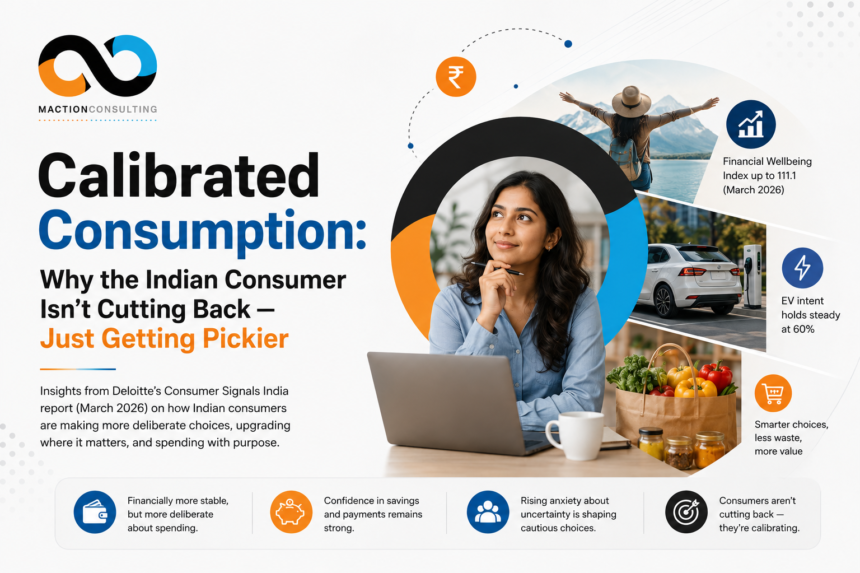
Deloitte’s latest Consumer Signals India report has put a name to something a lot of category-level research has been circling around for a while without quite pinning down: “calibrated consumption.” It’s a useful phrase because it resists the two easy, wrong stories brands tend to default to — that Indian consumers are either splurging freely or pulling back in fear. The actual picture, based on Deloitte’s tracking through March 2026, is neither. Households are financially more stable than a year ago, but they’re being noticeably more deliberate about where that stability gets spent — and the specific pattern of what’s getting cut, what’s getting upgraded, and what’s staying untouched is where the real research value sits.
The Headline Number Doesn’t Match the Mood
India’s Financial Wellbeing Index rose to 111.1 in March 2026, up from 109.1 a year earlier, and comfortably ahead of both the global average (102.7) and the Asia-Pacific average (102.0). By that measure alone, the story should be confidence, not caution. Yet in the same wave, consumer willingness to make large non-essential purchases fell five percentage points month-on-month to 65%, and a reported 73% of consumers said they’re bracing for higher prices ahead. That combination — genuinely improving financial footing alongside declining willingness to spend big — is exactly the gap “calibrated consumption” is meant to describe, and it’s a gap most simple consumer confidence-index tracking collapses into a single number.
Where the Discipline Is, and Where It Isn’t
The more useful detail in the report is category-specific, not aggregate. Around 79% of consumers say they’re confident about meeting upcoming payments, and 60% say they’re comfortable with their savings levels — genuinely reassuring numbers. But vehicle purchase intent softened by 12 points year-on-year, with 43% of consumers saying their current vehicle still meets their needs and 12% citing outright hesitation around large expenditure during uncertain times. Meanwhile, electric vehicle purchase intent held steady at 60%, and travel spending is shifting toward premium, upgraded experiences even as overall big-ticket intent softens. On the frugality side, 31% of households report actively reducing food waste and roughly 12% are trading down to lower-cost options — but only 11% say they’re buying less than they actually want, suggesting most households are managing cost pressure through smarter choices rather than genuine deprivation.
Anxiety Is Rising Even as Financial Confidence Improves
Perhaps the most important nuance in the report is that the caution isn’t purely financial in origin. Concern around political and geopolitical uncertainty rose from 25% in March 2025 to 33% in March 2026, and anxiety linked to broader societal unrest is also climbing. In other words, some of what looks like price sensitivity in the spending data may actually be a general-uncertainty response rather than a strict affordability constraint — a distinction that matters enormously for how a brand should respond. A category losing sales to genuine affordability pressure needs a pricing or value-tier response; a category losing sales to generalised anxiety about the world needs a confidence and reassurance response instead. Most trackers don’t separate the two, and Deloitte’s data suggests they increasingly should.
Why “Trading Down” Is the Wrong Frame for What’s Happening
The instinct when discretionary spending softens is to assume a broad shift toward cheaper alternatives across the board. Deloitte’s data doesn’t support that as the dominant pattern. Instead, it describes consumers prioritising essentials, upgrading selectively within experience-led categories like travel, and deferring large one-off commitments like vehicles — while premium and EV segments hold up specifically because they’re seen as forward-looking or value-durable rather than indulgent. That’s a genuinely different segmentation logic than a simple premium-versus-value split, and it argues for research that asks not just “will you spend less” but “which categories have earned the right to still get your discretionary rupee, and why.”
What to Build Into Research From Here
- Separate affordability-driven caution from anxiety-driven caution. With political and societal-unrest concern both rising independently of the financial wellbeing numbers, category trackers should test which driver is actually behind a softening purchase intent before recommending a pricing response.
- Map which of your category’s sub-segments have “earned trust” for discretionary spend. EVs and premium travel are holding up specifically because consumers see them as future-oriented rather than indulgent — understanding whether your category can be framed the same way is a positioning question, not just a pricing one.
- Test deferral versus abandonment directly. A consumer deferring a vehicle purchase because their current one “still meets their needs” is a very different research and marketing problem than one who has abandoned the purchase entirely — the former is a nurture and timing opportunity, the latter isn’t.
- Watch the gap between financial wellbeing and spending intent as its own indicator. When the two numbers move in opposite directions, as they are now, that gap itself is worth tracking quarter to quarter as a leading signal of sentiment shifting ahead of actual financial capacity.
Frequently Asked Questions
Q: What is calibrated consumption in India?
Calibrated consumption is a term from Deloitte’s Consumer Signals India report describing the current pattern of Indian consumer spending — households are financially more stable than a year ago but more deliberate about where that stability gets spent. They’re not cutting back broadly; they’re prioritising essentials, upgrading selectively in experience-led categories, and deferring large one-off commitments. It’s neither a spending boom nor a broad pullback.
Q: What does Deloitte’s Consumer Signals India report show about financial confidence?
India’s Financial Wellbeing Index rose to 111.1 in March 2026, up from 109.1 the prior year, and ahead of both the global average (102.7) and Asia-Pacific average (102.0). Despite this, willingness to make large non-essential purchases fell five percentage points month-on-month to 65%, and 73% of consumers said they’re expecting higher prices ahead — a gap between improving financial footing and declining willingness to spend big.
Q: Why is vehicle purchase intent falling in India despite improving financial confidence?
Vehicle purchase intent softened by 12 points year-on-year in Deloitte’s March 2026 data, with 43% of consumers saying their current vehicle still meets their needs and 12% citing hesitation around large expenditure during uncertain times. This is primarily a deferral pattern rather than abandonment — consumers are making do with what they have rather than committing to a large purchase in an uncertain environment. EV intent, by contrast, held steady at 60%.
Q: What is the difference between affordability-driven and anxiety-driven caution in consumer research?
Affordability-driven caution occurs when a consumer genuinely cannot afford a purchase — the appropriate brand response is pricing, value tiers, or EMI options. Anxiety-driven caution occurs when a consumer has the financial capacity but is hesitant due to broader uncertainty — the appropriate response is confidence-building and reassurance messaging. Deloitte’s data shows concern around political and geopolitical uncertainty rising from 25% to 33% year-on-year, suggesting a meaningful share of current spending caution is anxiety-driven rather than purely affordability-driven.
The Bigger Point
“Calibrated consumption” is a useful label precisely because it refuses to flatten Indian consumer behaviour into either a growth story or a slowdown story. The household balance sheet has genuinely improved; the willingness to spend freely against that improvement hasn’t followed at the same pace, and a meaningful share of that gap looks like it’s coming from general uncertainty rather than pure affordability. Brands that read this moment as a simple demand slowdown, and respond with blanket discounting, risk solving the wrong problem — the data suggests what many consumers actually need is a clearer reason to trust that a purchase is the right one, not just a lower price tag on it.
If you want to understand where your category sits within this calibrated-consumption shift, talk to our research team at Maction.