

Precision in AI is critical across domains like healthcare, autonomous driving, agriculture, and industrial inspection, where inaccuracies are unacceptable. Coarse annotations introduce error propagation, as models trained on rough object locations often overfit to irrelevant environmental cues instead of the target object.
Traditional methods like bounding boxes and keypoints have limitations because they only provide basic location information and cannot capture exact shapes. A fix to this problem is semantic segmentation, which provides exact shapes, boundaries, and spatial relationships between objects.
In this article, we will explain why semantic segmentation outperforms annotation methods like bounding boxes and keypoints and why it is necessary for precision AI systems.
Limitations of Bounding Boxes and Keypoints
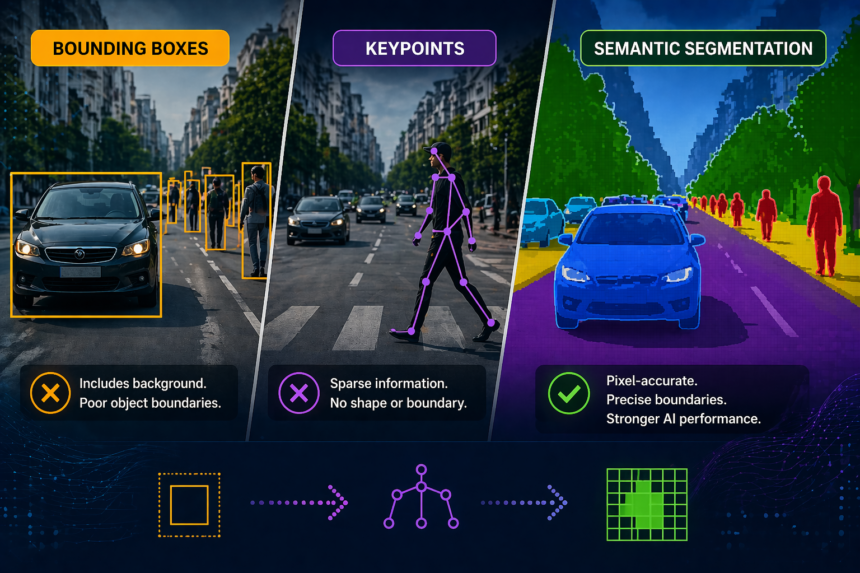
Bounding boxes are a common way to mark objects in computer vision, but they include pixels that are not part of the target object. For example, drawing a box around a person also includes the sidewalk, parked cars, and sky in the background. A model trained on box annotations cannot clearly distinguish the person from the surrounding context, reducing signal quality and forcing it to separate relevant features from background noise.
Another limitation is that boxes assume rectangular shapes. For instance, a car seen from an angle, a hand reaching into the frame, or a tumor against tissue don’t fit cleanly into a box.
Keypoints provide a sparse structure without full object geometry. A set of seventeen joints can describe a human skeleton, but they don’t show body contours, limb shape, or how the figure relates to nearby objects.
Performance also degrades in occlusion and dense scenes. For example, if a car passes behind a tree, the boxes around them overlap, making it hard for the model to tell which pixels belong to which object.
Semantic Segmentation as a High-Fidelity Representation
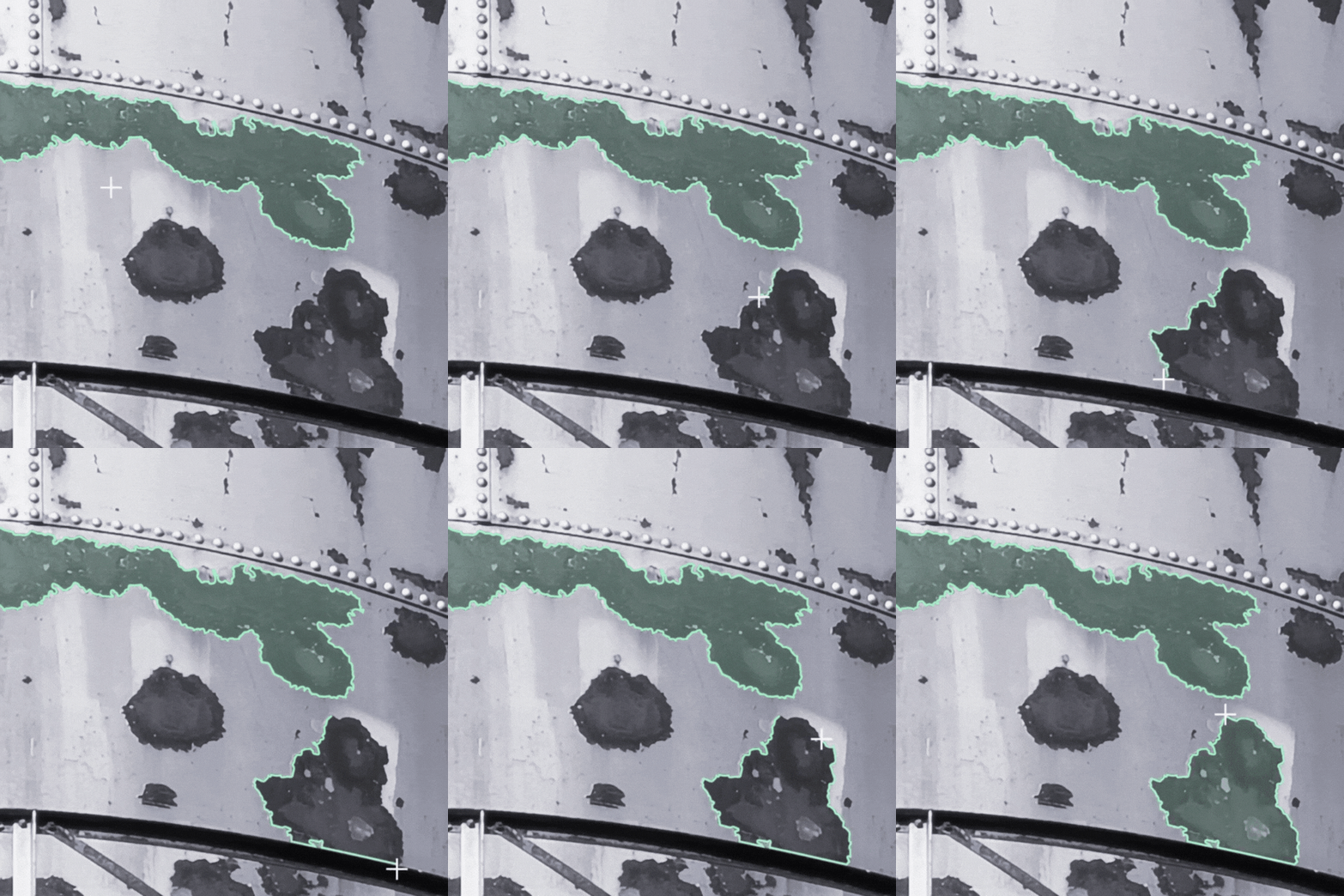
Semantic segmentation solves these structural challenges by performing dense, pixel-by-pixel classification. The output is a prediction map with the same spatial dimensions as the input image, where each pixel has a specific class assignment. This captures true object boundaries instead of approximating them.
Because labeling works at the pixel level, it does not impose any geometric restrictions on object shape. Objects with irregular boundaries, such as vascular structures in medical scans, road surfaces in aerial imagery, or fracture lines in industrial inspections, are labelled by tracing their actual contours.
Semantic image segmentation also removes the background contamination that is embedded in bounding box labels. Each pixel receives an explicit class assignment. If a pixel belongs to a pedestrian, it is labeled as a pedestrian; if it belongs to road, it is labeled as road. There is no implicit blending of foreground and background within an object’s annotation, which means feature learning is driven by clean, class-separated signal.
This detailed labeling also represents spatial relationships among objects. A model trained with segmentation data learns to interpret a scene as a structured arrangement of labelled regions. This enables more accurate reasoning about spatial context and layout.
Furthermore, accurate boundary delineation helps models assign classes to nearby and partially hidden objects. When bounding boxes overlap, annotations at shared boundaries are maintained, ensuring per-pixel class accuracy and allowing clear separation even in dense or layered scenes.
Impact on Model Performance and Spatial Understanding
Fine-grained supervision improves model accuracy and generalization. Training with exact boundaries improves signal-to-noise ratio, enabling better feature learning and allowing the model to focus purely on the target object.
This enables accurate handling of occlusions and small objects. Rather than guessing through an overlap, a pixel-trained model identifies the visible fragments of a partially hidden object, maintaining its tracking integrity.
Semantic segmentation also supports advanced spatial reasoning and contextual awareness, creating a strong foundation for complex tasks. Instance segmentation builds on it by separating individual objects within the same class.
Path planning and object manipulation in robotics depend on accurate scene maps created through map segmentation. Pixel-level training data improves the baseline for all of these downstream applications, which is why it is increasingly the preferred annotation format for precision AI pipelines.
Why Segmentation Wins in Precision-Critical Applications
In many industries, the difference between bounding boxes and segmentation masks directly impacts safety and performance.
Medical Imaging: Tissue and Boundary Delineation

Medical imaging demands the highest level of precision in AI. Clinicians require precise delineation of anatomical structures across MRI, CT, and X-rays.
- Tumor Delineation: A bounding box around a tumor indicates its general location, but a pixel-level mask is required to calculate its volume, growth rate, and margins for surgical planning.
- Organ Segmentation: For radiation therapy, segmenting the boundaries of at-risk organs is critical to ensure they receive a minimal dose while the target area receives a maximal dose.
- Pathology: In histopathology, segmenting individual cell boundaries and nuclei is necessary for grading cancer severity and selecting appropriate treatments.
Autonomous Systems: Pixel-Accurate Scene Understanding
Autonomous systems depend on a pixel-accurate understanding of their surroundings to navigate safely.
- Drivable Surface Analysis: AVs must distinguish between the road, lane markings, and pedestrian zones with absolute precision.
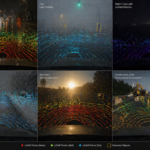
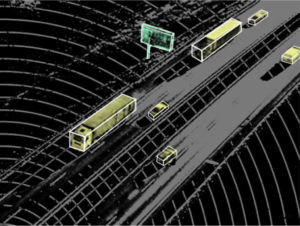
- 3D Point Cloud Perception: Using LiDAR, autonomous systems perform 3D semantic segmentation to label millions of points in a point cloud, enabling them to understand the environment in 3D.
- Obstacle Awareness: Segmentation allows the system to trace the exact contours of complex obstacles like fallen branches, construction barriers, or irregular debris on a highway.
Robotics: Precise Interaction and Manipulation
Advanced robotic tasks require the precision provided by semantic segmentation.
- Object Manipulation: To grasp a tool, a robotic arm needs to know where the handle is and how its hand will interact with that geometry.
- Navigation in Clutter: Robots in warehouses or homes must navigate through dense clutter. Segmentation identifies the exact gaps between objects that a robot can pass through.
- Surgical Robotics: In the operating room, robotic assistants must segment delicate tissues and blood vessels in real-time to avoid accidental injury during procedures.

Geospatial Analysis: Region and Asset Segmentation
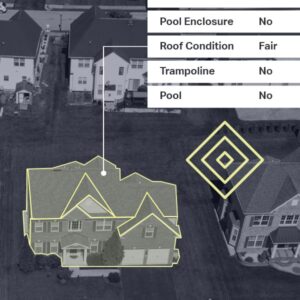
Geospatial analysis relies on segmentation for satellite, aerial, and drone imagery, as natural features rarely fit rectangular bounding boxes.
- Land Use Classification: Governments and environmental agencies use segmentation to track urban expansion, deforestation, and water body health.
- Agricultural Monitoring: Drones segment crop rows from weed patches to enable targeted spraying, which reduces costs and environmental impact.
- Infrastructure Management: The precision of map segmentation allows for mapping the exact footprints of buildings, and the routes of utility lines support disaster response and city planning.
Agriculture: Crop and Field-Level Precision

Precision agriculture depends on accurate segmentation for field-level decisions.
- Crop Health Monitoring: Segmentation identifies individual plant boundaries in drone and satellite imagery, enabling early detection of diseased or stressed crops.
- Weed vs. Crop Detection: Models trained on pixel-level masks can distinguish crop rows from weed patches with high accuracy, enabling targeted herbicide use and guiding weeding robots to remove weeds safely.
- Yield Estimation: Segmenting fruit clusters, plant canopies, and soil coverage gives agronomists precise data on crop density and projected yield, something bounding boxes cannot deliver at the required resolution.
Industrial Inspection: Defect-Level Localization
Industrial inspection requires defect-level localization to maintain safety and quality.
- Surface Inspection: Identifying the exact area and shape of scratches, cracks, or dirt on products like turbine blades or automotive parts.
- Component Boundary Detection: Robotic maintenance systems use segmentation to identify specific bolts, seals, or wires within a complex engine.
- Automated NDI: In non-destructive inspection (NDI), segmentation of ultrasonic scans allows for the detection of subsurface defects in aerospace composites without human intervention.
How iMerit Enables High-Precision Segmentation at Scale
Accurate semantic segmentation requires annotators with deep domain and visual expertise. iMerit uses expert-led pipelines for consistent pixel-level precision across complex datasets.
Advanced QA to Minimize Boundary Errors
iMerit employs quality rubrics to transform human intent into measurable parameters like IoU scores and boundary thresholds using the Ango Hub platform. These checks reduce noise and maintain consistency.
Multimodal and LiDAR Data Support
iMerit supports sensor fusion by synchronizing annotations across LiDAR, radar, and cameras. Annotators label 3D point clouds while cross-referencing 2D video to ensure spatial and temporal consistency across all modalities for a high-fidelity view of the environment.
Scalable Workforce Without Quality Loss
iMerit utilizes a global workforce of experts paired with AI-assisted labeling to overcome the high effort of manual segmentation. This hybrid model generates “first drafts” for human refinement, enabling faster processing without sacrificing precision.
Custom Domain-Specific Workflows
iMerit designs end-to-end workflows to meet specific regulatory or technical needs, such as HIPAA compliance or autonomous driving edge cases. From temporal consistency for mobility to arbitration workflows for medical AI, these custom solutions ensure datasets align perfectly with client architectures.
Conclusion
Precision AI requires exact data. Bounding boxes and keypoints offer rough approximations that introduce background noise and struggle with overlapping objects. Semantic segmentation assigns a specific class to every pixel, capturing exact boundaries and full object geometry. This improves accuracy, handles occlusions and enables advanced reasoning. For high-stakes applications, semantic segmentation is the only reliable choice for building safe and effective AI systems.
Are you looking for data experts to advance your semantic segmentation project? Here’s how iMerit can help.