

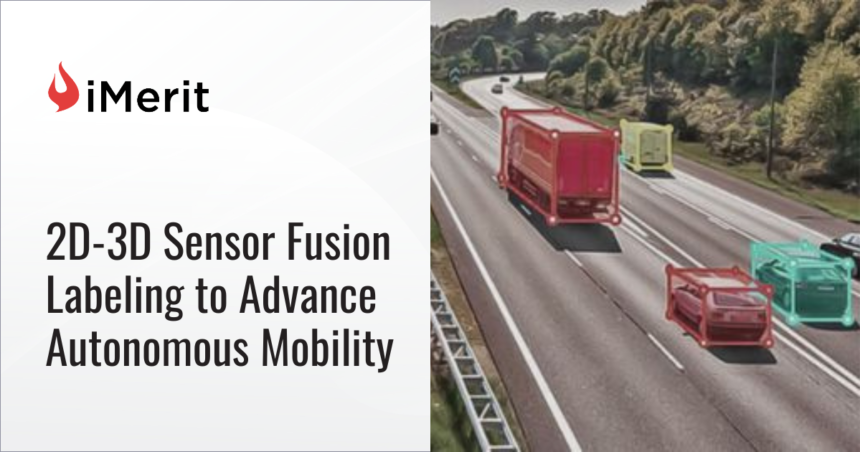
In the pursuit of achieving Level 4 and 5 autonomous driving, the integration of various sensors has become crucial. According to a report by NXP, achieving L4/5 autonomous driving may require integrating up to 8 radars, 8 cameras, 3 LiDARs, and other sensors. Each sensor possesses its strengths and weaknesses, making it clear that no single sensor can fulfill all the requirements for autonomous driving.
Autonomous vehicles must employ a fusion of multiple sensor systems to ensure a dependable and safe driving experience. Integrating sensor data is vital in developing resilient self-driving technology to navigate diverse driving scenarios and adapt to varying environmental conditions.
Sensor fusion enables the amplification of the unique strengths of each sensor. For instance, LiDAR is exceptional at delivering depth data and recognizing the three-dimensional structure of objects. On the other hand, cameras play a crucial role in identifying visual characteristics like the color of a traffic signal or a temporary road sign, especially over long distances. Meanwhile, radar proves highly efficient in adverse weather conditions and when moving objects need tracking, such as an animal unexpectedly running onto the road.
7 Key Labeling Types for Multi-Sensor Fusion
3D Bounding Box/Cuboid
3D bounding box annotation accounts for a depth /height of an image apart from length and breadth. It provides information about the object’s position, size, and orientation, which is crucial for object detection and localization.
3D Object Tracking
3D object tracking involves assigning unique identifiers to objects across multiple frames in a sequence. It requires labeling the objects’ positions and trajectories over time, enabling applications such as autonomous driving and augmented reality.
2D-3D Linking
2D-3D linking involves establishing correspondence between objects in 2D images and their corresponding 3D representations. It requires annotating both the 2D image and the corresponding 3D point cloud, enabling tasks such as visualizing the 3D structure of objects from 2D images.
Point Cloud Semantic Segmentation
Point Cloud semantic segmentation involves assigning semantic labels to individual points in a 3D point cloud. This labeling technique enables the understanding and categorization of different parts of objects or scenes in 3D, facilitating applications such as autonomous navigation and scene understanding.
Object Classification
Object classification involves labeling objects in a 3D scene with specific class labels. It focuses on categorizing them into predefined classes, providing information about the types of objects present in the scenario.
3D Polyline
3D polyline labeling entails annotating continuous lines or curves in a 3D space. It is apt for road or lane marking, where precise delineation of boundaries or paths is required.
3D Instance Segmentation
3D instance segmentation involves labeling individual instances of objects in a 3D scene with unique identifiers. It provides detailed information about the object boundaries and allows for distinguishing between multiple instances of the same object class.
Each of these diverse labeling requirements plays a vital role in sensor fusion, where data from multiple sensors, such as cameras and LiDAR, are integrated to create a comprehensive understanding of the environment in 3D. These labels enable robust perception systems for various applications, including autonomous driving, robotics, and augmented reality.
Advances in LiDAR-Camera Fusion and Real-Time Labeling Frameworks
As autonomous vehicle technology matures, fusion systems are becoming more sophisticated in how they process and interpret multi-sensor data. These evolving capabilities are raising the bar for data labeling quality and precision, making expert annotation services increasingly critical for training next-generation perception systems.
Next-Generation Fusion Approaches for Enhanced Detection
Advanced fusion systems are now leveraging deep learning architectures such as Siamese networks built on YOLO-v5 backbones that process LiDAR and camera data in parallel, enabling more accurate object detection across challenging scenarios. By converting LiDAR point clouds into depth images and fusing them with camera data at multiple processing stages, these systems achieve superior performance in detecting small, occluded, or distant objects. Testing on the KITTI benchmark, a widely recognized standard for autonomous driving evaluation, demonstrates these fusion approaches deliver real-time performance with processing speeds under 30 milliseconds per frame, while outperforming single-sensor systems, particularly in the complex conditions autonomous vehicles encounter daily.
Rigorous Testing Frameworks for Fusion System Validation
As fusion systems advance, the industry has developed more sophisticated methods to validate their reliability before deployment. Modern testing frameworks like MultiTest can synthesize realistic multi-sensor scenarios by inserting 3D objects into synchronized camera and LiDAR data streams, allowing development teams to evaluate system performance across thousands of edge cases. When tested on state-of-the-art perception systems using the KITTI dataset, MultiTest successfully identified hundreds of system weaknesses across different fault categories, including object missing errors, localization errors, and false detections. When the generated test scenarios are incorporated into retraining workflows, they can improve system robustness by approximately 24% in average precision, ultimately contributing to safer and more reliable autonomous driving systems.
6 Benefits of Outsourcing Sensor-Fusion Data Labeling
Enhanced Accuracy and Quality
Data labeling companies have dedicated teams of trained annotators who specialize in sensor fusion tasks, ensuring accurate labeling and reducing errors that may arise from in-house labeling.
Scalability
As sensor data increases in complexity and volume, outsourcing ensures that a data labeling partner can quickly scale up their resources and meet the demands without putting strain on internal teams, resulting in faster turnaround times.
Flexibility
Data labeling partners that offer custom labeling workflows provide a tailored approach that aligns with the specific needs and requirements of the sensor fusion project. This benefit ensures that the labeling process is optimized for the unique characteristics and complexities of the data, leading to more accurate and precise annotations.
Domain Expertise
Data labeling partners that include a workforce with domain expertise in sensor fusion tasks understand the nuances of labeling different sensor modalities, such as LiDAR, radar, and cameras, and can effectively handle various sensor fusion use cases. Leveraging their expertise can lead to more accurate and reliable labeled data for training sensor fusion algorithms.
Cost-effectiveness
Outsourcing data labeling needs for sensor fusion can be cost-effective compared to building an in-house team. Setting up an internal data labeling infrastructure, including hiring and training annotators, acquiring labeling tools, and managing the process, can be expensive. Outsourcing allows organizations to focus on their core competencies while benefiting from the cost savings of leveraging external expertise.
Time Savings
Data labeling is a time-consuming process that requires significant effort and attention to detail. By outsourcing this task, organizations can save valuable time and allocate resources to other critical aspects of their projects.
Power Your AI Models with iMerit’s Multi-Sensor Data Annotation Services
Highly accurate labeling of data collected from multiple sensors of an autonomous vehicle is crucial to improving the performance of computer vision models. At iMerit, we excel in multi-sensor annotation for camera, LiDAR, radar, and audio data, enhancing scene perception, localization, mapping, and trajectory optimization. Our teams utilize 3D data points with additional RGB or intensity values to analyze imagery within the frame, ensuring that annotations achieve the highest ground-truth accuracy.
Are you looking for data experts to advance your sensor fusion project? Contact our experts today to discover how iMerit can assist you.
References:
Real time object detection using LiDAR and camera fusion for autonomous driving | Scientific Reports
MultiTest: Physical-Aware Object Insertion for Testing Multi-sensor Fusion Perception Systems